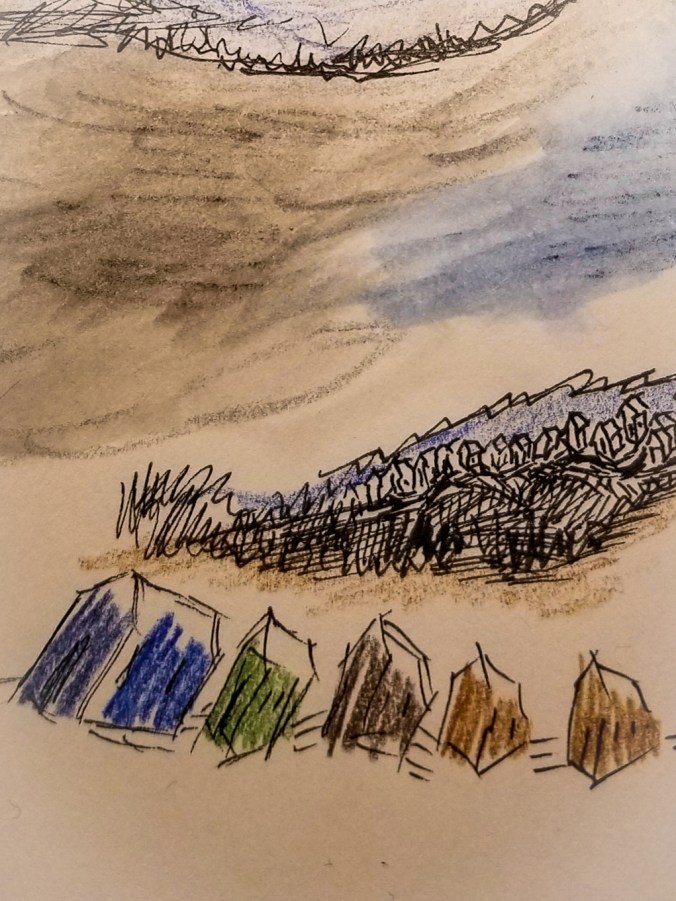
The End – Mark Strand

Not every man knows what he shall sing at the end,
Watching the pier as the ship sails away, or what it will seem like
When he’s held by the sea’s roar, motionless, there at the end,
Or what he shall hope for once it is clear that he’ll never go back.

When the time has passed to prune the rose or caress the cat,
When the sunset torching the lawn and the full moon icing it down
No longer appear, not every man knows what he’ll discover instead.
When the weight of the past leans against nothing, and the sky

Is no more than remembered light, and the stories of cirrus
And cumulus come to a close, and all the birds are suspended in flight,
Not every man knows what is waiting for him, or what he shall sing
When the ship he is on slips into darkness, there at the end.

DSC_6215 - Copy


stopping is not arriving

“In a Zen koan, someone said that an enlightened man is not one who seeks Buddha or finds Buddha, but simply an ordinary man who has nothing left to do. Yet stopping is not arriving. To stop is to stay a million miles from it and to do nothing is to miss it by the whole width of the universe.

“As for arriving, when you arrive you are ruined. Yet how close the solution is: how simple it would be to have nothing more to do if only one had really nothing more to do.

“The man who is unripe cannot get there, no matter what he does or does not do. But the ripe fruit falls out of the tree without even thinking about it. Why?

“The man who is ripe discovers there was never anything to be done from the very beginning.”

– Thomas Merton’s Journal, March 10, 1963

“Every concept grasped by the mind becomes an obstacle in the quest for those who search.”

– Gregory of Nyssa

10603351_10201598026591671_244432430516375036_n

Breathing Underwater by Sr. Carol Bieleck, RSCJ

I built my house by the sea.
Not on the sands, mind you,
not on the shifting sand.
And I built it of rock.
A strong house
by a strong sea.
And we got well acquainted, the sea and I.
Good neighbors.
Not that we spoke much.
We met in silences,
respectful, keeping our distance
but looking our thoughts across the fence of sand.
Always the fence of sand our barrier,
always the sand between.
And then one day
(and I still don’t know how it happened)
The sea came.
Without warning.
Without welcome even.
Not sudden and swift, but a shifting across the sand like wine,
less like the flow of water than the flow of blood.
Slow, but flowing like an open wound.
And I thought of flight, and I thought of drowning, and I thought of death.
But while I thought, the sea crept higher till it reached my door.
And I knew that there was neither flight nor death nor drowning.
That when the sea comes calling you stop being good neighbors,
Well acquainted, friendly from a distance neighbors.
And you give your house for a coral castle
And you learn to breathe under water.

You can purchase Breathing Under Water: Spirituality and The Twelve Steps by Richard Rohr OFM from the Center for Action and Contemplation Book Store http://store.cac.org/Breathing-Under-Water_p_15.html

pexels-photo-260551.jpeg


Listen to the spirit – Henri Nouwen

Living a spiritual life requires a change of heart, a conversion. Such a conversion may be marked by a sudden inner change, or it can take place through a long, quiet process of transformation. But it always involves an inner experience of oneness. We realize that we are in the center, and that from there all that is and all that takes place can be seen and understood as part of the mystery of God’s life with us. Our conflicts and pains, our tasks and promises, our families and friends, our activities and projects, our hopes and aspirations, no longer appear to us a fatiguing variety of things that we can barely keep together, but rather as affirmations and revelations of the new life of the Spirit in us. “All these other things,” which so occupied and preoccupied us, now come as gifts or challenges that strengthen and deepen the new life that we have discovered. This does not mean that the spiritual life makes things easier or takes our struggles and pains away. The lives of Jesus’ disciples clearly show that suffering does not diminish because of conversion. Sometimes it even becomes more intense. But our attention is no longer directed to the “more or less.” What matters is to listen attentively to the Spirit and to go obediently where we are being led, whether to a joyful or a painful place.

pexels-photo-737533.jpeg