Christmas at Greccio

Assisi-day5-fresco5

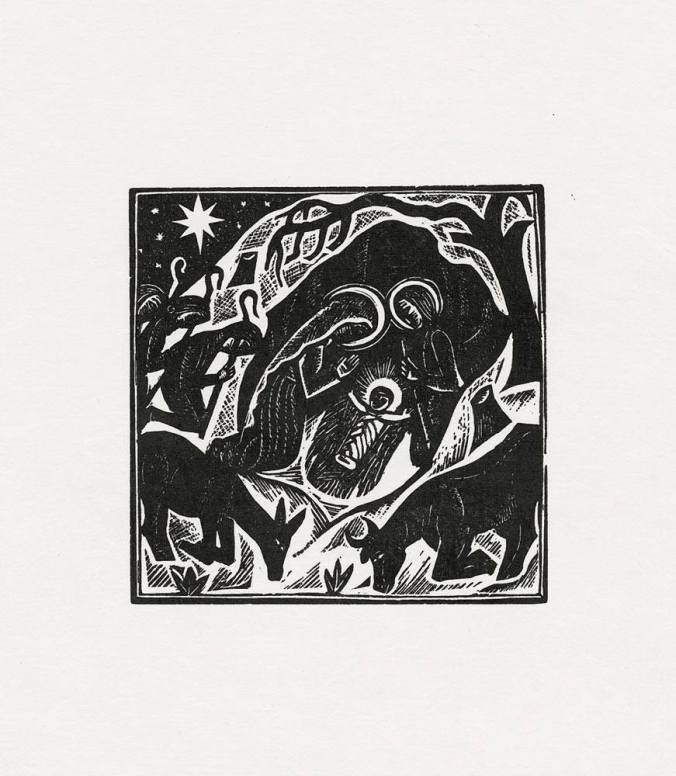
My friend and advisor, the Franciscan scholar Bill Short OFM, writes about the first nativity scene in his book on Franciscan spirituality – Poverty and Joy.

Two weeks before Christmas in 1223, Francis was staying in the little hillside hermitage near the town of Greccio, south of Assisi. According to his contemporary, Brother Thomas of Celano, Francis called a friend of his, named Giovanni, to help him in preparing a special celebration of the forthcoming feast. He asked that animals and hay be brought to a cave at the hermitage, so that a scene could be prepared to show the people of the town and his own brothers the physical conditions of the birth of Jesus.

He wanted people to be able to experience what it was like for the Son of God to be born in a stable, surrounded by the ox and ass, straw and cold. Francis’ brothers and the people of the town of Greccio gather in the cave on Christmas Eve, lighting up the night with torches, singing hymns, with a priest celebrating Mass on an altar arranged over the manger. Francis himself, ‘dressed as a Levite’, sang the gospel ‘in a beautiful voice,’ and preached, full of emotion. Thomas tells us that it seemed as if the infant Jesus, long forgotten in the hearts of people, came to life that night. And all of creation, the trees and stones of the surrounding mountainside, echoed the praises sung by the people.

This simple kind of nativity scene was destined to be spread by Franciscans throughout the world as they moved out from Assisi in the following centuries. It is by now a familiar feature of Christmas celebrations throughout the world. Though it has suffered its share of commercialization, and its significance has sometimes become purely sentimental, at its origins the nativity scene was a striking affirmation of God’s entry into the mundane, everyday life of poor people, the world of creatures, the world of straw and rocks.


THE INCARNATION MEANS GOD IS IN THE ORDINARY – Ronald Rolheiser

10623516_10203988114902385_8844332931311581880_o

Nikos Kazantzakis, the author of Zorba the Greek, once told this parable:

A man came up to Jesus and complained to him about the hiddenness of God. “Rabbi,” he said, “I am an old man. During my whole life, I have always kept the commandments. Every year of my adult life, I went to Jerusalem and offered the prescribed sacrifices.

“Every night of my life, I have not retired to my bed without first saying my prayers. But . . . I look at stars and sometimes the mountains—and wait, wait for God to come so that I might see him. I have waited for years and years, but in vain. Why, Why? Mine is a great grievance, Rabbi? Why doesn’t God show himself?

Jesus, in response, smiled gently and said: “Once upon a time there was a marble throne at the eastern gate of a great city. On this throne sat 3,000 kings. All of them called upon God to appear so that they might see him, but all of them went to their graves with their wishes unfulfilled.

“Then, when these kings had died, a pauper, barefooted and hungry, came and sat upon that throne. ‘God,’ he whispered, ‘the eyes of a human being cannot look directly at the sun, for they would be blinded. How then, Omnipotent, can they look directly at you?

“Have pity, Lord, temper your strength, turn down your splendor so that I, who am poor and afflicted, may see you! “Then—listen, old man—God became a piece of bread, a cup of cool water, a warm tunic, a hut and, in the front of the hut, a woman giving suck to an infant.

“Thank you, Lord,’ he whispered. ‘You humbled yourself for my sake. You became bread, water, a warm tunic and my wife and son in order that I might see you. And I did see you. I bow down and worship your beloved many-faced face!’”

The God who is born at Christmas, the Christ of the incarnation, is more domestic than monastic. He was eventually crucified, as a poet once put it, for making God as accessible as the village well.

We celebrate many things at Christmas, not the least of which is how scandalously easy it now is to see God. Likewise, there are many challenges to the Christmas mystery, not the least of which is, precisely, to be able to see the many-faced face of God in a piece of bread, a cup of water, and in our own homes and families.

After the incarnation, every home is a monastery, every child is the Christ child, and all food and drink is a sacrament.

We struggle to believe this. For many reasons, each of us has the propensity to miss seeing God in the ordinary because we are forever searching for him in the extraordinary. We tend, nearly always, to miss the sacredness of the domestic as we look for the sacred in the monastic.

Too often we are unaware that the incarnation fundamentally changed us from being theists to being Christians, that is, from being people who believe in God to becoming people who believe in a god who was made flesh in Christ.

What’s the difference? Christmas is the difference and Kazantzakis’ parable sheds valuable light on what Christmas really means. To understand the parable of God’s many-faced face, is to understand what the very word “Christ” means.

The word “Christ” is not Jesus’ second name (like Jack Smith, Susan Dolenski or Jesus Christ). Christ is a title, not a name. Literally, in Greek, it means: the anointed one. Jesus Christ=Jesus, the anointed one.

Part of the meaning of that however is that the anointed one is the one who is God-in-the-flesh, God-in-carnus. Christmas then means God-in-the-physical just as it also means that the-physical-contains-God.

Kazantzakis puts it well. In the incarnation, in the mystery of Christmas, God does become a piece of bread, a cup of water, a warm tunic, a house, a spouse and a child. God’s many-faced face is everywhere.

We no longer need to look for God in extraordinary visions—a sunset will do. An incarnational God normally gives precisely that kind of vision! Likewise we don’t need to look for people with the stigmata to see the wounds of Christ—the pain in the faces of those we sit down at table with will do. God’s wounded body too is everywhere.

May the incarnation deeply bless our lives! May God’s many-faced face be present, sacramentally, in all of our Christmas celebrations—our food, our drink, our gifts, our family sharings. Likewise, may each of us struggle to give birth to God’s many-faced face so as to be more sacrament to those around us. God, we bow down and worship your beloved many-faced face.

Dirge Without Music by Edna St. Vincent Millay

I am not resigned to the shutting away of loving hearts in the hard ground.
So it is, and so it will be, for so it has been, time out of mind:
Into the darkness they go, the wise and the lovely.  Crowned
With lilies and with laurel they go; but I am not resigned.
Lovers and thinkers, into the earth with you.
Be one with the dull, the indiscriminate dust.
A fragment of what you felt, of what you knew,
A formula, a phrase remains,—but the best is lost.
The answers quick and keen, the honest look, the laughter, the love,—
They are gone.  They are gone to feed the roses.  Elegant and curled
Is the blossom.  Fragrant is the blossom.  I know.  But I do not approve.
More precious was the light in your eyes than all the roses in the world.
Down, down, down into the darkness of the grave
Gently they go, the beautiful, the tender, the kind;
Quietly they go, the intelligent, the witty, the brave.
I know.  But I do not approve.  And I am not resigned.

Too bruised to touch…

The Oblate priest and theologian, Ronald Rolheiser, writes about suicide once a year. He explains it this way – “So each year I write a column on suicide, hoping it might help produce more understanding around the issue and, in a small way perhaps, offer some consolation to those who have lost a loved one in this way. Essentially, I say the same things each year because they need to be said. As Margaret Atwood once put it, some things need to be said and said and said again, until they don’t need to be said any more.  Some things need still to be said about suicide.”

Talk about suicide does not come easy – particularly if you are someone who has lived and has seen the darkness lifted. Best, we may think, to ponder those dark moments alone. But this morning I will be on my knees giving thanks to God for another chance to breathe deeply, to laugh, to cry, to feel pain and heartbreak, to feel remorse and sorrow, to love. This afternoon I will give thanks for all who have held me up when I couldn’t stand. This evening I will close my eyes and pray for all those who suffer alone, even when in a crowd, may they – like me – find refuge in the shadow of God’s wings.

Rolheiser writes:

What things? What needs to be said, and said again and again about suicide?  For the sake of clarity, let me number the points:

  1. First, in most cases, suicide is the result of a disease, a sickness, an illness, a tragic breakdown within the emotional immune system or simply a mortal biochemical illness.
  2. For most suicides, the person dies, as the does the victim of any terminal illness or fatal accident, not by his or her own choice. When people die from heart attacks, strokes, cancer, and accidents, they die against their will. The same is true in suicide.
  3. We should not worry unduly about the eternal salvation of a suicide victim, believing (as we used to) that suicide is the ultimate act of despair. God’s hands are infinitely more understanding and gentler than our own. We need not worry about the fate of anyone, no matter the cause of death, who leaves this world honest, over-sensitive, over-wrought, too bruised to touch, and emotionally-crushed, as is the case with most suicides. God’s understanding and compassion exceed our own. God isn’t stupid.
  4. We should not unduly second-guess ourselves when we lose a loved one to suicide: What might I have done? Where did I let this person down? What if? If only I’d been there at the right time!Rarely would this have made a difference. Most of the time, we weren’t there for the very reason that the person who fell victim to this disease did not want us to be there. He or she picked the moment, the spot, and the means precisely so we wouldn’t be there. Suicide seems to be a disease that picks its victim precisely in such a way so as to exclude others and their attentiveness. This is not an excuse for insensitivity, but is a healthy check against false guilt and fruitless second-guessing. Suicide is a result of sickness and there are some sicknesses which all the love and care in the world cannot cure.
  5. Finally, it’s incumbent upon us, the loved ones who remain here, to redeem the memory of those who die in this way so at to not let the particular manner of their deaths become a false prism through which their lives are now seen. A good person is a good person and a sad death does not change that. Nor should a misunderstanding.

DSC_5192

Inscription for the Entrance to a Wood – William Cullen Bryant

Stranger, if thou hast learned a truth which needs
No school of long experience, that the world
Is full of guilt and misery, and hast seen
Enough of all its sorrows, crimes, and cares,
To tire thee of it, enter this wild wood
And view the haunts of Nature. The calm shade
Shall bring a kindred calm, and the sweet breeze
That makes the green leaves dance, shall waft a balm
To thy sick heart. Thou wilt find nothing here
Of all that pained thee in the haunts of men
And made thee loathe thy life. The primal curse
Fell, it is true, upon the unsinning earth,
But not in vengeance. God hath yoked to guilt
Her pale tormentor, misery. Hence, these shades
Are still the abodes of gladness; the thick roof
Of green and stirring branches is alive
And musical with birds, that sing and sport
In wantonness of spirit; while below
The squirrel, with raised paws and form erect,
Chirps merrily. Throngs of insects in the shade
Try their thin wings and dance in the warm beam
That waked them into life. Even the green trees
Partake the deep contentment; as they bend
To the soft winds, the sun from the blue sky
Looks in and sheds a blessing on the scene.
Scarce less the cleft-born wild-flower seems to enjoy
Existence, than the winged plunderer
That sucks its sweets. The massy rocks themselves,
And the old and ponderous trunks of prostrate trees
That lead from knoll to knoll a causey rude
Or bridge the sunken brook, and their dark roots,
With all their earth upon them, twisting high,
Breathe fixed tranquillity. The rivulet
Sends forth glad sounds, and tripping o’er its bed
Of pebbly sands, or leaping down the rocks,
Seems, with continuous laughter, to rejoice
In its own being. Softly tread the marge,
Lest from her midway perch thou scare the wren
That dips her bill in water. The cool wind,
That stirs the stream in play, shall come to thee,
Like one that loves thee nor will let thee pass
Ungreeted, and shall give its light embrace.

DSC_4887