In Iceland, in early January,
when dusk begins at dawn,
alone in a wind-whipped shack,
I kneel as though cowering
before my little stove door.
Nights are immense, and my coal is black
as night.
A geologist
in his lab might be able to say,
within a million years or so, just
when and where the coal’s towering
source-plants were laid down;
I only know, while waiting for
the room to warm, it was very
long ago, and far away.

Life is the only way
to get covered in leaves,
catch your breath on the sand,
rise on wings;
to be a dog,
or stroke its warm fur;
to tell pain
from everything it’s not;
to squeeze inside events,
dawdle in views,
to seek the least of all possible mistakes.
An extraordinary chance
to remember for a moment
a conversation held
with the lamp switched off;
and if only once
to stumble on a stone,
end up drenched in one downpour or another,
mislay your keys in the grass;
and to follow a spark on the wind with your eyes;
and to keep on not knowing
something important.
Richard Rohr –
Fear is an addiction for a lot of people. They don’t know how to motivate themselves without being afraid of something. They don’t know how not to worry. When you’re living an inauthentic life, you’re going to worry because your subconscious, your spirit, knows your life has no truth. That is why we are creating so many fearful people.
The more illusory stuff we have to protect, the more fearful we will be. There’s almost a correlation between fears that people have and the false lives they live. Beneath all the layers of behavior, it is fear that brings more people into counseling than any other emotion. The counselor’s role is to help people identify what is behind their fear. Real lives start then.
Our bodies and our souls each have their separate aging process, and they aren’t always in harmony. Thus, T.E. Laurence, in, The Seven Pillars of Wisdom, makes this comment about someone: “He feared his maturity as it grew upon him, with its ripe thought and finished art, but which lacked the poetry of boyhood to make living a full end of life … his rangeful, mortal soul was aging faster than his body, was going to die before it, like most of ours.”
I suspect that all of us, at some level, fear growing into maturity. It’s not so much that we don’t want to give up the habits of our youth or that we fear that the joys of maturity are second-best to the pleasures of youth. There is, I believe, a deeper reason: We fear, as Laurence puts it, that our maturity will strip us of the poetry of our youth and make us old before time. What’s meant by that?
We sometimes speak of an old soul inside a young person, and this is meant both as a compliment and a criticism, perhaps more the latter. We sometimes look at a young person whose body is full of life and overfull with energy and see a precociousness of soul that belies that youth and energy and we can’t help wondering whether that premature maturity isn’t inhibiting the life-principle. And so we have a mixed reaction: What a mature young person! But is his or her life too-grey and sterile before its time?
Reflecting on this, I was reminded of a comment that Raymond Brown once made in a class. The context of his remark is important: This was not the comment of a young man still looking to leave a mark on life, but rather the comment of a very mature, successful, and respected man who was the envy of his peers. Nearly 70 years old, wonderfully mature, universally respected for everything from his scholarship to his personal integrity, he was a mature soul. And still his comment betrayed the subtle fear that perhaps his maturity had stripped him of some of the poetry of his boyhood. His comment was something to this effect:
You know when you reach a certain age, as I have now, and you look back on what you’ve done, you’re sometimes embarrassed by some of the things you did in your youth, not immoral things, just things that now, from your present perspective, seem immature and ill thought-out, things that you are now too wise to ever risk doing. Recalling them, initially you are a little embarrassed. But then, in those moments where you feel your age and your present reticence, you sometimes look back and say: “That’s bravest thing I ever did! Wow, I had nerve then! I’m much more afraid of things now!”
Jane Urquhart, the Canadian novelist, echoes this sentiment. Rereading one of her own books which she had written twenty years before, she comments: “It is tremendously satisfying to be able to reacquaint myself with the young woman who wrote these tales, and to know that what was going on in her mind intrigues me still.” What’s unspoken in her comment is her present admiration (and dare I say, envy) for the poetry that once infused her younger self.
I had a similar feeling some years ago when, for a new release of my book, The Restless Heart, I was asked to update it. I’d written the book when I was still in my twenties, a lonely and restless young man then, partly looking for my place in life. Now, nearly 25 years later and somewhat more mature, I was sometimes embarrassed by some of the things I’d written all those years back; but, like Raymond Brown, I marvelled at my nerve back then, and, like Jane Urquhart, it was refreshing to reacquaint myself with the young man who had written that book, sensing that he had a livelier poetry and more verve in him than the older person who was rereading that text.
Some of us never grow-up. The body ages, but the soul remains immature, clinging to adolescence, fearful of responsibility, fearful of commitment, fearful of opportunity slipping away, fearful of aging, fearful of own maturity, and, not least, fearful of death. This is not a formula for happiness, but one for an ever-increasing fear, disappointment, and bitterness in life. Not growing-up eventually catches up with everyone, and what judged as cute at twenty, colorful at 30, and eccentric at 40, becomes intolerable at 50. At a certain age, even poetry and verve don’t compensate for immaturity. The soul too must grow-up.
But, for some of us, the danger is the opposite, we grow old before our time, becoming old souls in still young bodies, mature, responsible, committed, able to look age, diminishment, and mortality square in the eye, but devoid of the poetry, verve, color, and humor which are meant to make a mature person mellow and alive, like a finely-aged old wine.
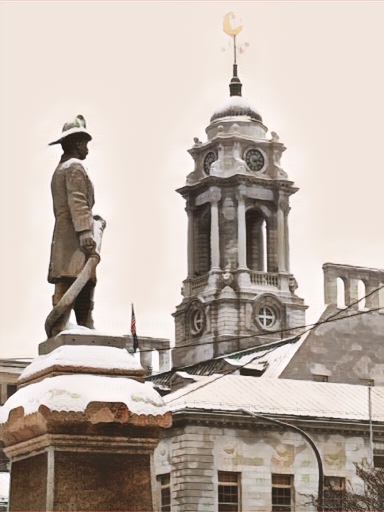
Photo: Portland, Maine – January 8, 2019
How beautiful on the mountains
are the feet of those who bring good news,
who proclaim peace
– Isaiah 52:7
Photo: Monastery of Christ in The Desert, Abiquiu, NM – September 2018


Photos: Greene, Maine – January 6, 2019
January 6, 2005 – The Feast of The Epiphany – The wind had blown around our barn for two or three hours before dawn. But as the sun appeared above the mountains to the east the winds stopped and wood smoke settled into the valley. Occasionally, the crack of a shotgun from bird hunters would echo through the hills. Soon, even the hunters and their dogs would be still.
It is the morning of the Feast of The Epiphany. Quiet prevails.
We are driving to Mount La Verna to celebrate Mass. It is not much more than eight or nine miles from our door to the road leading to the sanctuary – if we could drive in a straight line. But there are no straight roads in these hills so that eight or nine mile drive will take us 45 minutes. The residents of Caprese Michelangelo, Lama, Fragaiolo, Monte Foresto, and Assunzione, some no more than four or five dwellings and a small church, are still watching their children, grandchildren, nieces, and nephews opening gifts, for Epiphany is the day for gift-giving in this part of Italy.
We climb out of the valley, switchback after switchback. Halfway to La Verna and we are on the spine of a ridge and can look down into the valleys on either side of the road. We are now above the clouds, mist, and wood smoke that we had occasionally driven through. Back towards San Giustino, Citta’ di Castello, Perugia, and Assisi the mist and smoke is streaming through the valley like a great river. It tumbles into deeper valleys in vast cascades.
I stop the car. We need to take this in – this blessing – this grace-filled landscape we move through.
The parking lot at The Sanctuary of La Verna is nearly full when we arrive. Children with their parents and grandparents, all in their best holiday clothes, walk through the groves of beech trees to the cluster of old buildings that make up the Sanctuary. The January sun stays low on the horizon. The shadows from the tree branches are sharp and focused. The air is cold and pure.
In the Basilica for Mass, we are all cold but happy to huddle shoulder to shoulder. I think I can see my breath as I whisper my responses in english. There are joyful faces, joyful beings gathered in line to receive the Eucharist. I eat the bread and drink the wine and my body is filled with the familiar, indescribable warmth.
When Mass has ended, we all go into the paizzalle. People are laughing. A boy is playing guitar. People gather around the great cross that seems to be rooted in the very heart of the world, singing and chattering like a flock of birds.


