Be still and know that I am God.
Be still and know that I am.
Be still and know.
Be still.
Be.
Be still and know that I am God.
Be still and know that I am.
Be still and know.
Be still.
Be.
the letter brings death, but the Spirit gives life
Baffling
Cunning
Richard Rohr ~
When we come to the end of our rope and hit rock bottom, we are not dashed but fall into God’s hands. It is here at our lowest that we discover our true source of power, the indwelling Holy Spirit. Many years ago, during a hermitage in Arizona, I had a particularly strong sense of the Holy Spirit, the One who is fully available to all of us “if we but knew the gift of God” (John 4:10). I slowly composed this prayer–imagining many names and movements of the Spirit–to awaken and strengthen this Presence within you. Recite it whenever you are losing faith in God or in yourself.
Pure Gift of God
Indwelling Presence
Promise of the Father
Life of Jesus
Pledge and Guarantee
Defense Attorney
Inner Anointing
Homing Device
Stable Witness
Peacemaker
Always Already Awareness
Compassionate Observer
God Compass
Inner Breath
Mutual Yearning
Hidden Love of God
Implanted Hope
Seething Desire
Fire of Life and Love
Truth Speaker
Flowing Stream
Wind of Change
Descending Dove
Cloud of Unknowing
Uncreated Grace
Filled Emptiness
Deepest Level of Our Longing
Sacred Wounding
Holy Healing
Will of God
Great Compassion
Inherent Victory
You who pray in us, through us, with us, for us, and in spite of us.
Amen, Alleluia!

“Living is a form of not being sure, not knowing what next or how. The moment you know how, you begin to die a little. The artist never entirely knows. We guess. We may
be wrong, but we take leap after leap in the dark.” – Agnes de Mille
“Prego” by Ingrid Wendt
Ask for something, Per
favore, please, the answer is
Prego. Please.
Thank you, Grazie, thank you,
you say. Instead of you’re welcome?
Prego. The answer is please.
Prego, listen, here in Italy, every
time you think you’re polite, this lift
of the verbal eyebrow, this rise
and fall of the voice like a hand
on its way to your shoulder, insistent
lifeline picking you up,
letting you go
again. No problem! Prego
pulls up the covers and tucks you in.
Cape of Saint Martin. Communion
wafer on each Italian tongue. Prego.
Please, Prego, I pray to you,
Prego, don’t
worry. Let me
do something for you.
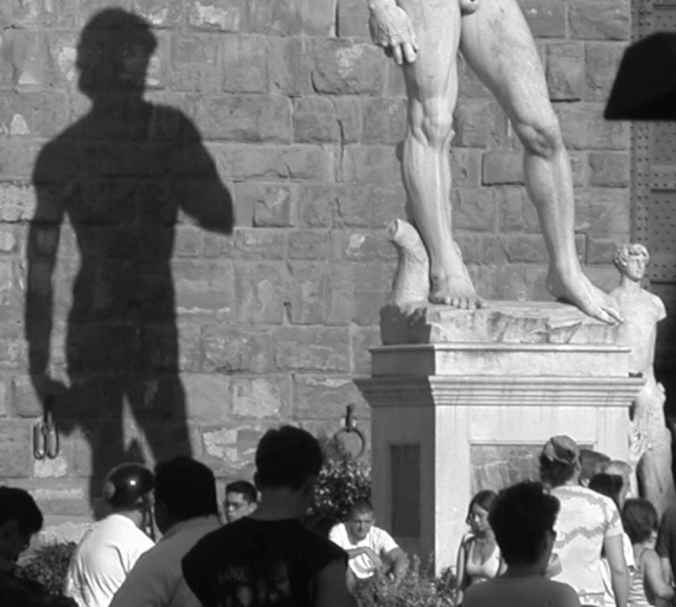
(Photo: Firenze, 2002)
Richard Rohr –
We are all addicts. Human beings are addictive by nature. Addiction is a modern name and description for what the biblical tradition calls “sin” and the medieval Christians called “passions” or “attachments.” They both recognized that serious measures, or practices, were needed to break us out of these illusions and entrapments; in fact, the New Testament calls them in some cases “exorcisms!” They knew they were dealing with non-rational evil or “demons.”
Substance addictions are merely the most visible form of addiction, but actually we are all addicted to our own habitual way of doing anything, our own defenses, and most especially our patterned way of thinking, or how we process our reality. By definition you can never see or handle what you are addicted to. It is always “hidden” and disguised as something else. As Jesus did with the demon at Gerasa, someone must say, “What is your name?” (Luke 8:30). You cannot heal what you do not first acknowledge.
 “Each time a man stands up for an ideal, or acts to improve the lot of others, or strikes out against injustice, he sends forth a tiny ripple of hope, and crossing each other from a million different centers of energy and daring those ripples build a current which can sweep down the mightiest walls of oppression and resistance.”
The conviction that I have not even begun to write, to think, to pray, and to live, and that only now am I getting down to waking up. And that, by God’s grace, this comes from finally trying, with great difficulty, to be genuinely free and alone, as humbly as I can, in God’s sight, without passively accepting all the standards and the formulas which have been adopted by others – or, at least, that I am now exercising a wider choice in my sources of inspiration. – Thomas Merton, journal entry, June 22, 1958
 Edge of Atlantic