Adversity introduces a man to himself. – Albert Einstein
#1097
Hell & Heaven
 There’s another story that you may have read that has to do with what we call heaven and hell, life and death, good and bad. It’s a story about how those things don’t really exist except as a creation of our own minds. It goes like this: A big burly samurai comes to the wise man and says, “Tell me the nature of heaven and hell.” And the roshi looks him in the face and says: “Why should I tell a scruffy, disgusting, miserable slob like you?” The samurai starts to get purple in the face, his hair starts to stand up, but the roshi won’t stop, he keeps saying, “A miserable worm like you, do you think I should tell you anything?” Consumed by rage, the samurai draws his sword, and he’s just about to cut off the head of the roshi. Then the roshi says, “That’s hell.” The samurai, who is in fact a sensitive person, instantly gets it, that he just created his own hell; he was deep in hell. It was black and hot, filled with hatred, self-protection, anger, and resentment, so much so that he was going to kill this man. Tears fill his eyes and he starts to cry and he puts his palms together and the roshi says, “That’s heaven.”
(Pema Chodron – From her book Awakening Loving Kindness)
Gelassenheit
Gelassenheit – letting go – not being encumbered by systems, words, projects. And yet being free in systems, projects. Not trying to get away from all action, all speech, but free, unencumbering Gelassen in this or that action. Error of self-conscious contemplatives: to get hung up on a certain kind of non-action which is an imprisonment, a stupor, the opposite of Gelassenheit. Actually quietism is incompatible with true inner freedom. The furden of this stupid and enforced “quiet” – the self sitting heavily on its own head.
Still thinking of K.C., who wrote from Cincinnati. From a certain point of view my letter to her was a scandal. I was in effect saying, “Don’t listen for the voice of God, God will not speak to you.” Yet this had to be said. Today, for a certain type of person, deceptive. It is the wrong kind of listening: listening for a limited message, an objective sound, a sensible meaning. Actually one decides one’s life by responding to a word that is not well defined, easily explicable, safely accounted for. One decides to love in the face of an unaccountable void, and from the void comes an unaccountable truth. By this truth one’s existence is sustained in peace – until the truth is too firmly grasped and too clearly accounted for. Then one is relying on words, i.e., on ones’ own understanding and one’s own ingenuity in interpreting existence and its “signs.” The one is lost and has to be found once again in the patient Void.
– Thomas Merton, journal entry, November 13, 1966
I walk a crooked road
A loving heart will fill my days with gladness
make joy out of sadness
when I show this loving heart to you…
Cells
once
I was hit hard
so hard
each cell
bruised
still
I’ll cry
for
once
the door
opened
the woman
left and
five men
shook
me
wrists hurt
first
or
the heart
mostly
I sat
on a bed
for hours
waiting
wait while
another guy
is hit hard
in all that dark
to myself
I said good-bye
good
good-bye

formula for gratitude
1095 (days) + 1@a time = 3
Muddy Water

“Muddy water is best cleared by leaving it alone.” – Alan Watts
huddling chairs

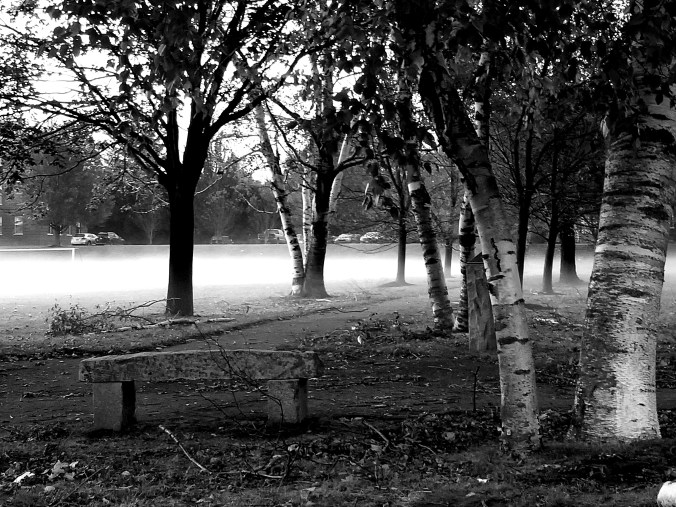
When I Am Among The Trees – Mary Oliver
When I am among the trees,
especially the willows and the honey locust,
equally the beech, the oaks, and the pines,
they give off such hints of gladness.
I would almost say that they save me, and daily.
I am so distant from the hope of myself,
in which I have goodness, and discernment,
and never hurry through the world
but walk slowly, and bow often.
Around me the trees stir in their leaves
and call out, “Stay awhile.”
The light flows from their branches.
And they call again, “It’s simple,” they say,
“and you too have come
into the world to do this, to go easy, to be filled
with light, and to shine.