two by Rilke

I Live My Life

I live my life in growing orbs,
which move out over the things of the world.
Perhaps I can never achieve the last,
but that will be my attempt.

I am circling around God, around the ancient tower,
and I have been circling for a thousand years,
and I still don’t know if I am a falcon, or a storm,
or a great song.


A Walk

My eyes already touch the sunny hill,
going far ahead of the road I have begun.
So we are grasped by what we cannot grasp;
it has its inner light, even from a distance –

and changes us, even if we do not reach it,
into something else, which, hardly sensing it, we already are;
a gesture waves us on, answering our own wave…
but what we feel is the wind in our faces.

(translated by Robert Bly)


Recall the joy of discovery

To keep the spirit of eternal youth active in us during the second half of life, we must learn again to play with our experience. Recall the joy of discovery before it bowed to work, obligation, and duty. Movement is alive; inertia is dead. We become more “unalive” as we cling to that which is predictable and unchanging. Enthusiasm is closely related to the spirit of play – the word comes from the ancient Greek theos, meaning “god.” To have enthusiasm is to allow yourself to be filled with divine assistance, so the ego does not need to handle your tasks by itself.
Robert A. Johnson, from Living Your Unlived Life


The Franciscan School of Theology

Image may contain: outdoor

This image of the former Franciscan School of Theology in Berkeley, CA goes straight to my heart. It was right about this time in 2003 that I climbed “Holy Hill” in Berkeley and first laid eyes on FST – the beautiful Tuscan yellow building at the top of the hill – the corner of Euclid and LeConte. I spent the next three years there immersed in the spirit of Francis and Clare of Assisi. I am so grateful for that time.

FST is now affiliated with The University of San Diego (https://www.fst.edu/)

Whole and holy people

Great love has the potential to open the heart space and then the mind space. Great suffering has the potential to open the mind space and then the heart space. Eventually both spaces need to be opened, and for such people, non-dual thinking can be the easiest.

People who have never loved or never suffered will normally try to control everything with an either-or attitude or all-or-nothing thinking. This closed system is all they are prepared for. The mentality that divides the world into “deserving and undeserving” has not yet experienced the absolute gratuity of grace or the undeserved character of mercy. This lack of in-depth God-experience leaves all of us judgmental, demanding, unforgiving, and weak in empathy and sympathy. Such people will remain inside the prison of “meritocracy,” where all has to be deserved. They are still counting when in reality God and grace exist outside of all accounting. Remember, however, to be patient with such people, even if you are the target of their judgment, because on some level, that is how they treat themselves as well.

Non-dual people will see things in their wholeness and call forth the same unity in others simply by being who they are. Wholeness (head, heart, and body all present, positive, and accounted for!) can see and call forth wholeness in others. This is why it is so pleasant to be around whole and holy people.

Dualistic or divided people, however, live in a split and fragmented world. They cannot accept or forgive certain parts of themselves. They cannot accept that God objectively dwells within them, as it states in so many places in Scripture, including 1 Corinthians 3:16-17. This lack of forgiveness takes the forms of a tortured mind, a closed heart, or an inability to live calmly and proudly inside ones own body. The fragmented mind sees parts, not wholes, in itself and others, and invariably it creates antagonism, reaction, fear, and resistance—“push-back” from other people—who themselves are longing for wholeness and holiness.
Richard Rohr

Happy 85th Birthday, Wendell Berry

Image result for wendell berry
The Peace of Wild Things
BY WENDELL BERRY

When despair for the world grows in me
and I wake in the night at the least sound
in fear of what my life and my children’s lives may be,
I go and lie down where the wood drake
rests in his beauty on the water, and the great heron feeds.
I come into the peace of wild things
who do not tax their lives with forethought
of grief. I come into the presence of still water.
And I feel above me the day-blind stars
waiting with their light. For a time
I rest in the grace of the world, and am free.

The reality of now

The grip the present has on me. That is the one thing that has grown most noticeably in the spiritual life – nothing much else has. The rest dims as it should. I am getting older. The reality of now – the unreality of the rest. The unreality of ideas and explanations and formulas. I am. The unreality of all the rest. The pigs shriek. Butterflies dance together against the blue sky at the end of the woodshed. The buzz saw stands outside there, half covered with dirty and tattered canvas. The trees are fresh and green in the sun (more rain yesterday). Small clouds, inexpressibly beautiful and silent and eloquent, over the silent woodlands. What a celebration of light, quietness, and glory! This is my feast, sitting here in the straw!
– Thomas Merton, journal entry – August 25, 1958

DSC_7743

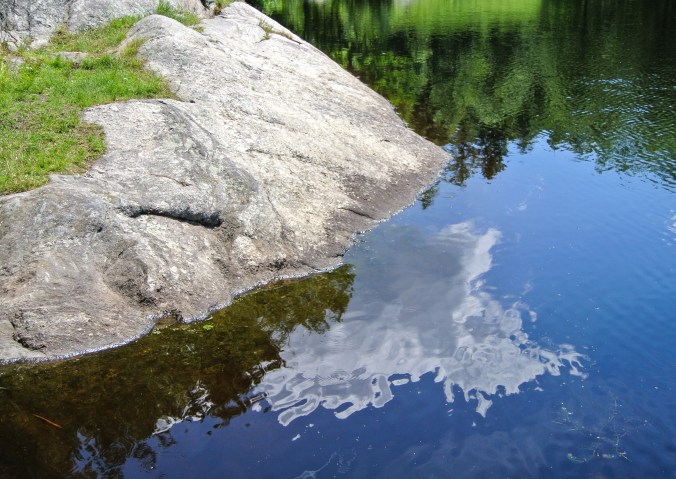
(photo: Runaround Pond, Maine – June 2019)

What finally counts

What finally counts is not whether we know Jesus and his words but whether we live our lives in the Spirit of Jesus. The Spirit of Jesus is the Spirit of Love. Jesus himself makes this clear when he speaks about the last judgment. There people will ask: “Lord, when did we see you hungry and feed you, or thirsty and give you drink?” and Jesus will answer: “In so far as you did this to one of the least … of mine, you did it to me” (Matthew 25:37, 40).

This is our great challenge and consolation. Jesus comes to us in the poor, the sick, the dying, the prisoners, the lonely, the disabled, the rejected. There we meet him, and there the door to God’s house is opened for us. – Henri Nouwen