I know how to live in humble circumstances; I know also how to live with abundance.
In every circumstance and in all things I have learned the secret of being well fed and of going hungry, of living in abundance and of being in need. I can do all things in him who strengthens me.
Still, it was kind of you to share in my distress.
Some days when you look out, the land is heavy, following its hills, dim where the road bends. There are days when having the world is a mistake. But then you think, “Well, anyway, it wasn’t my idea,” and it’s OK again.
Suppose that a person who knows you happens to see you going by, and it’s one of those days – for a minute you have to carry the load for them, you’ve got to lift the whole heavy world, even without knowing it, being a hero, stumbling along. Some days it’s like that. And maybe today. And maybe all the time.
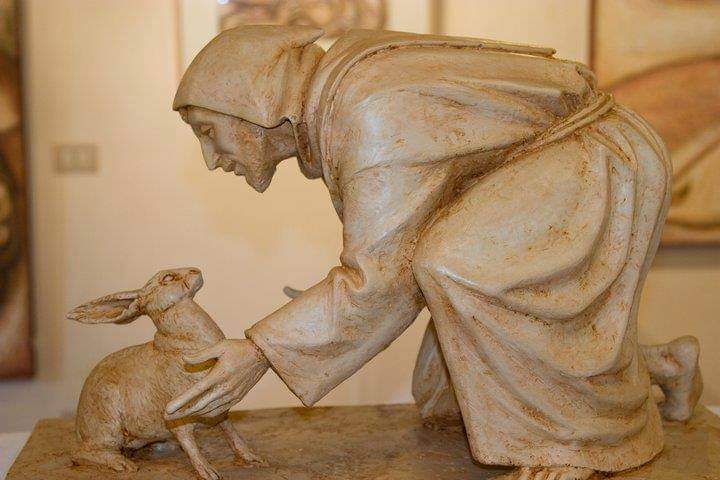
This evening, followers of St. Francis of Assisi will keep a memorial of his passing on October 3, 1226. I pray that his spirit of reconciliation and love for all creation bless each one of us.
Blessing of St. Francis – May God bless you and keep you, smiling graciously on you, granting mercy and peace, granting mercy and peace. May God bless you and keep you, May you see the face of God, granting mercy and peace, granting mercy and peace. Amen. Amen. Amen
On Resurrection Day your body testifies against you.
Your hand says, “I stole money.” Your feet, “I went where I shouldn’t.” Your genitals, “Me too.”
Your lips, “I said meanness.”
They will make your praying sound hypocritical. Let the body’s doings speak openly now, without your saying a word, as a student’s walking behind a teacher says, “This one knows more clearly than I the way.”
Thus says the LORD the God of hosts: Woe to the complacent in Zion! Lying upon beds of ivory, stretched comfortably on their couches, They eat lambs taken from the flock, and calves from the stall! Improvising to the music of the harp, like David, they devise their own accompaniment. They drink wine from bowls and anoint themselves with the best oils; yet they are not made ill by the collapse of Joseph! Therefore, now they shall be the first to go into exile, and their wanton revelry shall be done away with.
Mythologies, in other words, mythologies and religions, are great poems and, when recognized as such, point infallibly through things and events to the ubiquity of a ‘presence’ or ‘eternity’ that is whole and entire in each. In this function all mythologies, all great poetries, and all mystic traditions are in accord; and where any such inspiriting vision remains effective in a civilization, everything and every creature within its range is alive. The first condition, therefore, that any mythology must fulfill if it is to render life to modern lives is that of cleansing the doors of perception to the wonder, at once terrible and fascinating, of ourselves and of the universe of which we are the ears and eyes and the mind. Whereas theologians, reading their revelations counterclockwise, so to say, point to references in the past (in Merton’s words: ‘to another point on the circumference’) and Utopians offer revelations only promissory of some desired future, mythologies, having sprung from the psyche, point back to the psyche (‘the center’): and anyone seriously turning within will, in fact, rediscover their references in himself. — Joseph Campbell, “Myths To Live By”




 Edge of Atlantic