quiet and human

How high the corn is this year, and what joy there is in seeing it! The tall crests nodding twelve to fifteen feet above the ground and all the silk-bearded ears. You come down out of the novitiate, through the door in the wall, over the trestle, and down into this green paradise of stalks and silence. I know the joy and worship the Indians must have felt, and the Eucharistic rightness of it! How can one not feel such things – so that I love the Mayas and the Incas as perhaps the most human of peoples, as the ones who did most honor to our continents.

photo of corn field

Photo by Gustavo Rodrigues on Pexels.com

The irreligious mind is simply the unreal mind, the zombie, abstracted mind, that does not see things that grow in the earth and feel glad about them, but only knows prices and figures and statistics. In a world of numbers you can be irreligious, unless the numbers themselves are incarnate in astronomy and music. But, for that, they must have something to do with seasons and with harvests, with the joy of the Neolithic peoples, who for millennia were quiet and human.
– Thomas Merton, journal entry – July 26, 1963

The book of what one has lived

20190702_071414.jpg
Photo: Evergreen Cemetery, Portland, Maine – May 19, 2019

Either you look at the universe as a very poor creation out of which no one can make anything, or you look at your own life and your own part in the universe as infinitely rich, full of inexhaustible interest, opening out into the infinite further responsibilities for study and contemplation and interest and praise. Beyond all and in all is God.
Perhaps the book of life, in the end, is the book of what one has lived, and if one has lived nothing, one is not in the book of life.
– Thomas Merton, Journal entry


to be genuinely free and alone

The conviction that I have not even begun to write, to think, to pray, and to live, and that only now am I getting down to waking up. And that, by God’s grace, this comes from finally trying, with great difficulty, to be genuinely free and alone, as humbly as I can, in God’s sight, without passively accepting all the standards and the formulas which have been adopted by others – or, at least, that I am now exercising a wider choice in my sources of inspiration. – Thomas Merton, journal entry, June 22, 1958

The real home

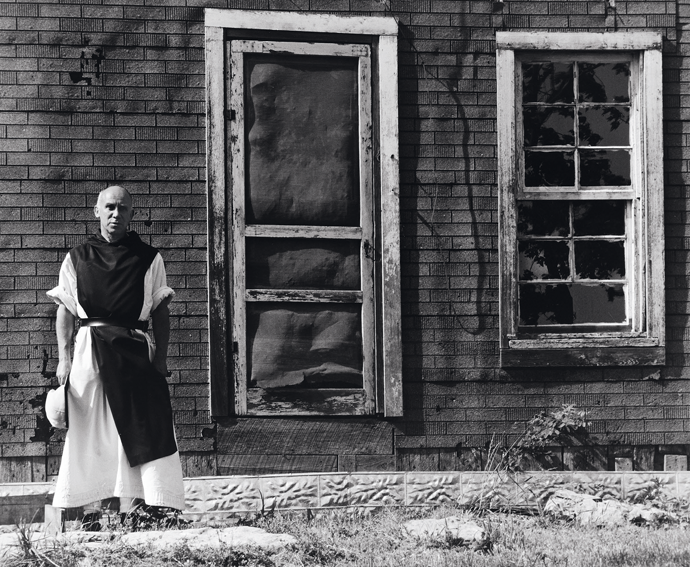
Image result for thomas merton

I sit in the cool back room, where words cease to resound, where all mornings are absorbed in the consonantia of heat, fragrant pine, quiet wind, birdsong, and one central tonic note that is unheard and unuttered. Not the meditation of books, or of pieties, or of systematic trifles. In the silence of the afternoon all is present and all is inscrutable. One central tonic note to which every other sound ascends or descends, to which every other meaning aspires, in order to find its true fulfillment. To ask when the note will sound is to lose the afternoon: it has sounded, and all things now hum with the resonance of its sounding.    – Thomas Merton, journal entry, May 1965

The country that is nowhere is the real home.   – journal entry, May 30, 1968

Wake up and be vigilant

“The Lord has plucked up proud men by their roots, and planted the lowly peoples.” “He has put down the mighty.”
If I were more attentive to the word of God I would be much less troubled and disturbed by events of our time: not that I would be indifferent or passive, but I could gain strength of union with the deepest currents of history, the sacred currents, which run opposite to those on the surface a great deal of the time!
“Do not quarrel about a matter that does not concern you; and when sinners judge, do not sit in council with them.” (Ecclesiastes).
This especially strikes me: “Be wary, take very great care, because you are walking with your own downfall; when you hear such things, wake up and be vigilant.” It seems to me that at the moment I very much need this kind of “attention” and “listening,” for I have come to the most serious moments of my life.
– Thomas Merton, journal entry, May 11, 1965

Hang on to the clear light!

lighted candle

Photo by Rahul on Pexels.com

Not that I must undertake a special project of self-transformation or that I must “work on myself.” In that regard, it would be better to forget it. Just go for walks, live in peace, let change come quietly and invisibly on the inside.
But I do have a past to break, with an accumulation of inertia, waste, wrong, foolishness, rot, junk, a great need of clarification, of mindfulness, or rather of no mind – a return to genuine practice, right effort, need to push on to the great doubt. Need for the spirit.
Hang on to the clear light!
– Thomas Merton, Journal entry, May 30, 1968

The vanity of our best efforts

From Tertullian: Malim nullum bonum quam vanum. “I would rather have nothing than have vanity.”
When we face the vanity of our best efforts, their triviality, their involvement in illusion, we become desperate. And then we are tempted to do anything as long as it seems to be good. We may abandon a better good with which we have become disillusioned and embrace a lesser good with a frenzy that prevents us from seeing the greater illusion.
So, through effort that may seem to be wasted, we must patiently go towards a good that is to be given to the patient and the disillusioned.
– Thomas Merton, Journal entry, May 29/30. 1962
merton4.278190127_std