and after this our exile…
thankful
This is the way…
Though the Lord may give you the bread of adversity and the water of affliction, yet your Teacher will not hide any more, but your eyes shall see your Teacher. And when you turn to the right or when you turn to the left, your ears shall hear a word behind you, saying, “This is the way; walk in it.” – Isaiah 30:20-21
It’s not easy to believe in God.
Ronald Rolheiser –
It’s not easy to believe in God. Faith is never certitude and the evidence for God’s existence is ambiguous. It is ambiguous because life is. The world is full of beauty, virtue, love, selflessness, artistic achievement, humor and celebration. It is, at the same time, full too of evil, moral and physical – selfishness, murder, rape, exploitation, insensitivity, stupidity, and death-producing phenomena, parasites, cancer, and natural disasters which inflict death, pain, disease, and destruction randomly and senselessly.
One can look at the world, as countless believers have always done, and conclude from the presence of beauty and love that there exists an all-loving and all-beautiful God who created this all out of love. One can also look at the world, as many sincere atheists (e.g. Gordon Sinclair, Albert Camus, Richard Rubenstein, Simone de Beauvoir) have, and conclude from the presence of suffering and evil that no God exists or, if one does, s/he is either malicious, quixotic or incompetent. Millions of persons have trouble believing in God, or being at peace with their belief, because they see an inconsistency between faith in an all-good God and the presence of suffering and evil in the world. As Albert Camus once put it: “If there is a God, then he is the eternal bystander with his back turned on a suffering world.”
What underlies these criticisms which often come from very sincere persons? What underlies them is a confusion, however sincere, between faith and understanding. Simply put, whenever we try to think God we get into trouble. Why? Because mind, imagination, and thought cannot be stretched far enough to adequately understand God. For this reason, when we do try to figure out how there can be a God and how everything can still be imagined consistently, we end up with the unfounded conclusion that God does not exist.

Photo by Pixabay on Pexels.com
Let me illustrate with just one example of what happens when we try to image God’s existence.
The very immensity of our universe defies imagination: There are perhaps hundreds of millions of galaxies with billions of light years separating them. On each of these planets within these galaxies there are hundreds of trillions of phenomena happening every second (and through billions of years). Can we really believe that somewhere there is a person and a heart so supreme and omniscient that it created all of this and that, right now, it knows minutely and intimately every detail and happening and that it is passionately concerned with every one of these happenings? To expatiate further with just one small example: our planet earth. This is just one of millions of planets.
Yet, just on it, during every second there are hundreds of persons being born, hundreds of persons are being conceived, hundreds are dying, millions are sinning, millions are doing virtuous acts, millions are suffering, millions are celebrating, millions are hoping, millions are praying, many are despairing…and all of this has been happening for hundreds of thousands of years. Can we really imagine that a God exists who intimately knows all of this, in every detail, cares passionately about each individual and every detail, and is, somehow, Lord over all of this so that “no sparrow falls from the sky or hair from a human head” without God knowing and caring deeply? Can we really imagine this?
The answer quite simply is that we can’t. Our minds and imaginations simply won’t stretch that far. But that is the precise point. The biggest religious mistake we can make is to try to imagine God. God is infinite, our minds are finite. It makes for a bad equation. When we make God fit the categories of what we can think and imagine we end up in trouble. When God asked Moses to take his shoes off before the burning bush, God was asking for space – space within which to be God. Our belief in God can only be strong if we respect the mystery that is God and not try to figure out God or make God fit into the limits of our own imaginations.
When we do this, and it is the perennial temptation, when we try to make God consistent with our imaginations, then God ceases being God, ceases being worth believing in, and we soon stop believing.
We are takers – Walter Brueggeman
You are the giver of all good things.
All good things are sent from heaven above,
rain and sun,
day and night,
justice and righteousness,
bread to the eater and
seed to the sower,
peace to the old,
energy to the young,
joy to the babes.
We are takers, who take from you,
day by day, daily bread,
taking all we need as you supply,
taking in gratitude and wonder and joy.
And then taking more,
taking more than we need,
taking more than you give us,
taking from our sisters and brothers,
taking from the poor and the weak,
taking because we are frightened, and so greedy,
taking because we are anxious, and so fearful,
taking because we are driven, and so uncaring.
Give us peace beyond our fear, and so end our greed.
Give us well-being beyond our anxiety, and so end our fear.
Give us abundance beyond our drivenness,
and so end our uncaring.
Turn our taking into giving … since we are in your giving image:
Make us giving like you,
giving gladly and not taking,
giving in abundance, not taking,
giving in joy, not taking,
giving as he gave himself up for us all,
giving, never taking. Amen.
ultimate peace
Are the great visions of the ultimate peace among all people and the ultimate harmony of all creation just utopian fairy tales? No, they are not! They correspond to the deepest longings of the human heart and point to the truth waiting to be revealed beyond all lies and deceptions. These visions nurture our souls and strengthen our hearts. They offer us hope when we are close to despair, courage when we are tempted to give up on life, and trust when suspicion seems the more logical attitude. Without these visions our deepest aspirations, which give us the energy to overcome great obstacles and painful setbacks, will be dulled and our lives will become flat, boring, and finally destructive. Our visions enable us to live the full life.
– Henri Nouwen
For I, the Lord your God, hold your right hand; it is I who say to you, “Do not fear, I will help you.” – Isaiah 41:13
poetry & prayer
I have never separated the writing of poetry from prayer. I have grown up believing it is a vocation, a religious vocation. What I described in Another Life—about being on the hill and feeling the sort of dissolution that happened—is a frequent experience in a younger writer. I felt this sweetness of melancholy, of a sense of mortality, or rather of immortality, a sense of gratitude both for what you feel is a gift and for the beauty of the earth, the beauty of life around us. When that’s forceful in a young writer, it can make you cry. It’s just clear tears; it’s not grimacing or being contorted, it’s just a flow that happens. The body feels it is melting into what it has seen. This continues in the poet. It may be repressed in some way, but I think we continue in all our lives to have that sense of melting, of the ‘I’ not being important. That is the ecstasy. It doesn’t happen as much when you get older.
There’s that wonderful passage in [Thomas] Traherne where he talks about seeing the children as moving jewels until they learn the dirty devices of the world. It’s not that mystic. Ultimately, it’s what Yeats says: ‘Such a sweetness flows into the breast that we laugh at everything and everything we look upon is blessed.’ That’s always there. It’s a benediction, a transference. It’s gratitude, really. The more of that a poet keeps, the more genuine his nature. I’ve always felt that sense of gratitude. I’ve never felt equal to it in terms of my writing, but I’ve never felt that I was ever less than that.
– Derek Walcott
Moving Forward – Rainer Maria Rilke (translated by Robert Bly)
The deep parts of my life pour onward,
as if the river shores were opening out.
It seems that things are more like me now,
that I can see farther into paintings.
I feel closer to what language can’t reach.
With my senses, as with birds, I climb
into the windy heaven, out of the oak,
and in the ponds broken off from the sky
my feeling sinks, as if standing on fishes.
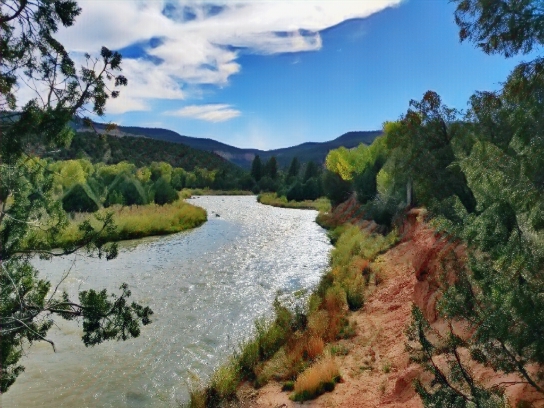
(photo: Chama River, NM – September 2018)
Prego – Ingrid Wendt
Ask for something, Per
favore, please, the answer is
Prego. Please.
Thank you, Grazie, thank you,
you say. Instead of you’re welcome?
Prego. The answer is please.
Prego, listen, here in Italy, every
time you think you’re polite, this lift
of the verbal eyebrow, this rise
and fall of the voice like a hand
on its way to your shoulder, insistent
lifeline picking you up,
letting you go
again. No problem! Prego
pulls up the covers and tucks you in.
Cape of Saint Martin. Communion
wafer on each Italian tongue. Prego.
Please, Prego, I pray to you,
Prego, don’t
worry. Let me
do something for you.
(Photo: Assisi, 2002)

The Lord is close to the broken-hearted.
– Psalm 34:18

 Edge of Atlantic