Jesus was concerned with the healing of human shame and human guilt. He was always taking away people’s shame, always taking away their low self-esteem, and reintroducing them to the village, the temple, the priesthood, and their families. He was healing relationships even more than just healing bodies. And now many would say that we (the Church/Christians) have ended up being the chief purveyors of guilt and shame, instead of healing it and transforming it into life and light. We have decided, for some reason, that it is better to remind people of their unworthiness and brokenness, instead of their potential to be temples of the Holy Spirit. It became taught and learned helplessness in far too many cases. – Richard Rohr, OFM
shame
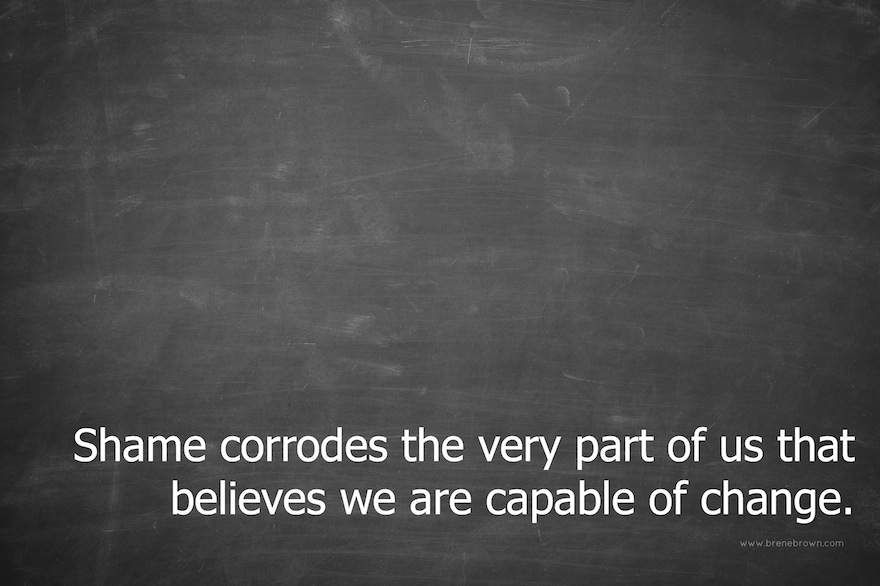
Consider how you have fared
Now therefore thus says the Lord of hosts: Consider how you have fared. You have sown much, and harvested little; you eat, but you never have enough; you drink, but you never have your fill; you clothe yourselves, but no one is warm; and you that earn wages earn wages to put them into a bag with holes.
– Haggai 1:5-6

Photo by Harry Smith on Pexels.com
Until we walk with despair

(Photo: Berkeley, CA – April 2006)
Until we walk with despair, and still have hope, we will not know that our hope was not just hope in ourselves, in our own successes, in our power to make a difference, in our image of what perfection should be. We need hope from a much deeper Source. We need a hope larger than ourselves.
Until we walk with personal issues of despair, we will never uncover the Real Hope on the other side of that despair. Until we allow the crash and crush of our images, we will never discover the Real Life beyond what only seems like death. Remember, death is an imaginary loss of an imaginary self, that is going to pass anyway.
This very journey is probably the heart of what Jesus came to reveal.
– Richard Rohr
found drawing – January 16, 2017

“And acceptance is the answer to all my problems today. When I am disturbed, it is because I find some person, place, thing, or situation – some fact of my life – unacceptable to me, and I can find no serenity until I accept that person, place, thing, or situation as being exactly the way it is supposed to be at this moment. Nothing, absolutely nothing, happens in God’s world by mistake.” – AA Big Book
stop searching
stop thinking
stop trying
the way out
is there
found drawing – 12.22.2016

hours after
winter solstice
the day I wanted to die,
tried, and failed
I had failed at success
and succeeded in failure
today and every day
I am grateful for life
(… Some speak of the future
My love she speaks softly
She knows there’s no success like failure
And that failure’s no success at all…)
– Bob Dylan, Love Minus Zero/No Limit
sheep or shepherd?

(photo: Greene, ME – January 2019)
Then Jesus told them this parable: “Suppose one of you has a hundred sheep and loses one of them. Doesn’t he leave the ninety-nine in the open country and go after the lost sheep until he finds it? And when he finds it, he joyfully puts it on his shoulders and goes home. Then he calls his friends and neighbors together and says, ‘Rejoice with me; I have found my lost sheep.’ I tell you that in the same way there will be more rejoicing in heaven over one sinner who repents than over ninety-nine righteous persons who do not need to repent.
– Luke 15:3-7
#1019
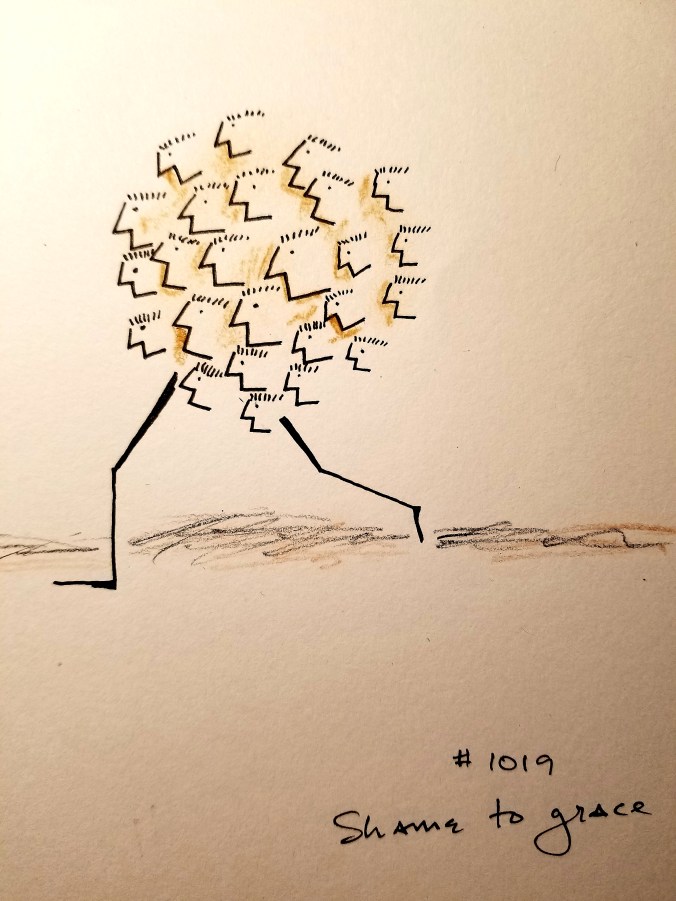
It just comes. That is the miracle of it.
Plum Trees
The blossoming plums are a comforting sight,
they understand I am heavy with wine
– Chiang K’uei
do you recall
when I planted plum trees
to the east of our home
the scent at dusk
promised a life still
as a Chinese scroll
later in darkness
I turned away
and seemed to sleep
so many winters
my head heavy
my plum trees gone

Photo by Irina Iriser on Pexels.com
 Edge of Atlantic