If it were possible for us to see further than our knowledge reaches, and a little beyond the outworks of our intuitions, perhaps we should then bear our sadnesses with greater assurance than our joys. For they are the moments when something new enters into us, something unknown to us; our feelings, shy and inhibited, fall silent, everything in us withdraws, a stillness settles on us, and at the centre of it is the new presence that nobody yet knows, making no sound.
To bless means to say good things. We have to bless one another constantly. Parents need to bless their children, children their parents, husbands their wives, wives their husbands, friends their friends. In our society, so full of curses, we must fill each place we enter with our blessings. We forget so quickly that we are God’s beloved children and allow the many curses of our world to darken our hearts. Therefore we have to be reminded of our belovedness and remind others of theirs. Whether the blessing is given in words or with gestures, in a solemn or an informal way, our lives need to be blessed lives.
When you finally come to maturity, you can look back at your life and forgive every bit of it. You can let go of everyone who hurt you, even your first wife or husband. You don’t even need to hate the church that hurt you. Wisdom is where you see it all and you eliminate none of it and include all of it as important training. Finally, “everything belongs.” You are able to say, from some larger place that even surprises you, “It is what it is” and even the “bad” was good.
These are the people who will change the world. These are the people who will transform history. We call them “larger than life” because they are living more than their own life. As Paul says, “I live no longer, not I, but Christ lives in me” (Galatians 2:20). Non-dualistic people are able to be fully present to the now and trust God with the future and the past. God can use them because their small and petty self is finally out of the way.
The false self is the prison from which one must escape in order to reach the true self, and God. For if I find him, I will find myself, and if I find myself, I will find him.
Chama River, Monastery of Christ in the Desert, Abiquiu, NM
The false self is your psychological creation of yourself in space and time. It comes from your early conditioning, family, roles, education, mind, culture, and religion. The false self is who you think you are! But thinking doesn’t make it so. The false self dies and passes away. Yet it is the raw material through which you discover your True Self in God, so you must not hate it or kill it. Just learn from it. Of itself, it does not know how to pray, because it does not understand simple presence, communion, or relationship. The false self is all about utility and “What can I get out of this?” Not bad, but very incomplete. The True Self is not created by anything you have done right or wrong. Nor can you lose it by doing anything good or bad. The True Self is not formed by adhering to any requirements; it’s about relationship itself—the quality and capacity for connection. Only the True Self can pray. The false self will say prayers but the True Self is a prayer and looks out at reality from a different pair of eyes larger than its own. This is why in Ephesians it can say “pray always” (6:18). We pray always whenever we act in conscious and loving union with things—which eventually can be all the time. Then whatever you do is a prayer, not a recited prayer but a full-bodied, bigger-than-mind, contemplative prayer. When you are in your True Self, your prayer and your breath are the same thing. – R. Rohr
When in the soul of the serene disciple With no more Fathers to imitate Poverty is a success, It is a small thing to say the roof is gone: He has not even a house.
Stars, as well as friends, Are angry with the noble ruin. Saints depart in several directions.
Be still: There is no longer any need of comment. It was a lucky wind That blew away his halo with his cares, A lucky sea that drowned his reputation.
Here you will find Neither a proverb nor a memorandum. There are no ways, No methods to admire Where poverty is no achievement. His God lives in his emptiness like an affliction.
What choice remains? Well, to be ordinary is not a choice: It is the usual freedom Of men without visions.
Without solitude there can be no real people. The more you discover what a person is, and experience what a human relationship requires in order to remain profound, fruitful and a source of growth and development, the more you discover that you are alone, and thus the measure of your solitude is the measure of your capacity for communion. – Henri Nouwen, from The Genesee Diaries
Sometimes our spiritual programs take us far away from our inner belonging. We become addicted to the methods and programs of psychology and religion. We become so desperate to learn how to be, that our lives pass, and we neglect the practice of being. One of the lovely things in the Celtic mind is its sense of spontaneity, which is one of the greatest spiritual gifts. To be spontaneous is to escape the cage of the ego by trusting that which is beyond the self. One of the greatest enemies of spiritual belonging is the ego. The ego does not reflect the real shape of one’s individuality. The ego is the false self born out of fear and defensiveness. The ego is a protective crust that we draw around our affections. It is created out of timidity, the failure to trust the Other and to respect our own Otherness. One of the greatest conflicts in life is the conflict between the ego and the soul. The ego is threatened, competitive, and stressed, whereas the soul is drawn more toward surprise, spontaneity, the new and the fresh. Real soul has humor, irony, and no obsessive self-seriousness. It avoids what is weary, worn, or repetitive. The image of the well breaking out of the hard, crusted ground is an illuminating image for the freshness that can suddenly dawn within the heart that remains open to experience. – John O’Donohue from Anam Cara
Richard Rohr – Great love has the potential to open the heart space and then the mind space. Great suffering has the potential to open the mind space and then the heart space. Eventually both spaces need to be opened, and for such people, non-dual thinking can be the easiest.
People who have never loved or never suffered will normally try to control everything with an either-or attitude or all-or-nothing thinking. This closed system is all they are prepared for. The mentality that divides the world into “deserving and undeserving” has not yet experienced the absolute gratuity of grace or the undeserved character of mercy. This lack of in-depth God-experience leaves all of us judgmental, demanding, unforgiving, and weak in empathy and sympathy. Such people will remain inside the prison of “meritocracy,” where all has to be deserved. They are still counting when in reality God and grace exist outside of all accounting. Remember, however, to be patient with such people, even if you are the target of their judgment, because on some level, that is how they treat themselves as well.
Non-dual people will see things in their wholeness and call forth the same unity in others simply by being who they are. Wholeness (head, heart, and body all present, positive, and accounted for!) can see and call forth wholeness in others. This is why it is so pleasant to be around whole and holy people.
Dualistic or divided people, however, live in a split and fragmented world. They cannot accept or forgive certain parts of themselves. They cannot accept that God objectively dwells within them, as it states in so many places in Scripture, including 1 Corinthians 3:16-17. This lack of forgiveness takes the forms of a tortured mind, a closed heart, or an inability to live calmly and proudly inside ones own body. The fragmented mind sees parts, not wholes, in itself and others, and invariably it creates antagonism, reaction, fear, and resistance—“push-back” from other people—who themselves are longing for wholeness and holiness.
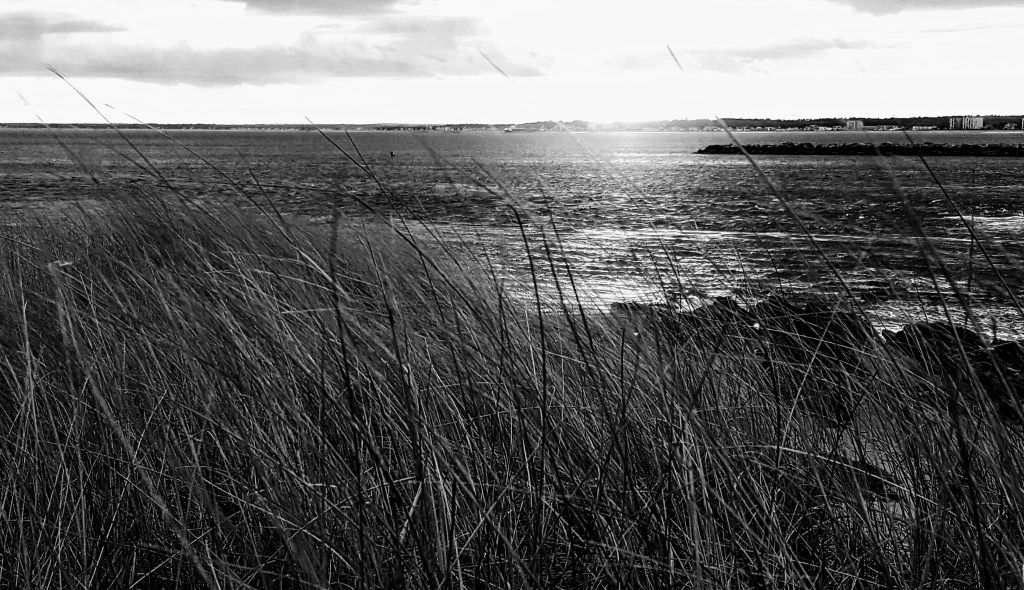



 Edge of Atlantic