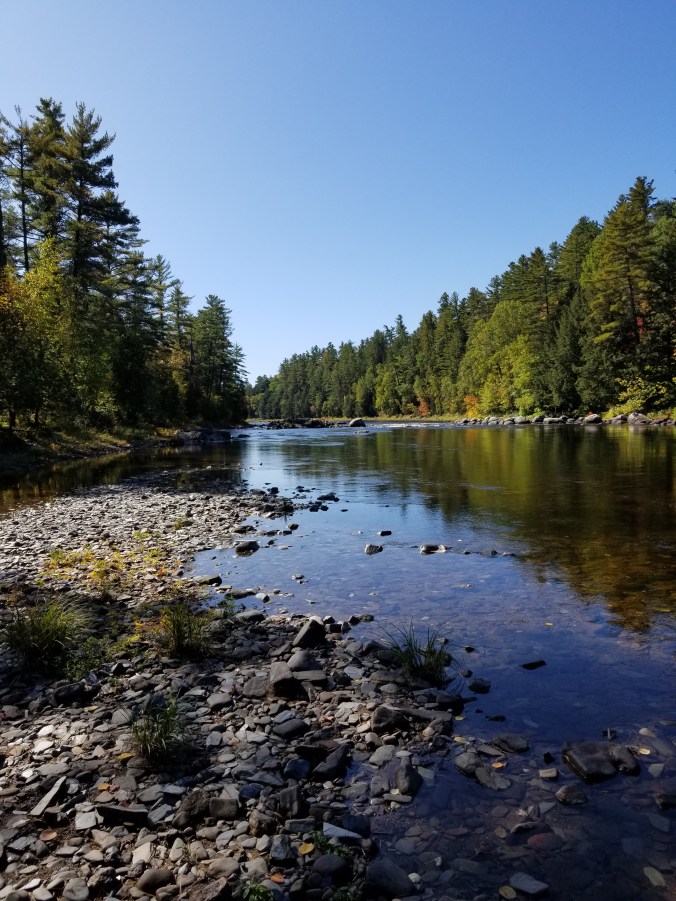
Climbing along the River – William Stafford

Willows never forget how it feels
to be young.

Do you remember where you came from?
Gravel remembers.

Even the upper end of the river
believes in the ocean.

Exactly at midnight
yesterday sighs away.

What I believe is,
all animals have one soul.

Over the land they love
they crisscross forever.

20190927_104924.jpg

Poem – Elizabeth Bishop

About the size of an old-style dollar bill,
American or Canadian,
mostly the same whites, gray greens, and steel grays
-this little painting (a sketch for a larger one?)
has never earned any money in its life.
Useless and free., it has spent seventy years
as a minor family relic handed along collaterally to owners
who looked at it sometimes, or didn’t bother to.

It must be Nova Scotia; only there
does one see abled wooden houses
painted that awful shade of brown.
The other houses, the bits that show, are white.
Elm trees., low hills, a thin church steeple
-that gray-blue wisp-or is it? In the foreground
a water meadow with some tiny cows,
two brushstrokes each, but confidently cows;
two minuscule white geese in the blue water,
back-to-back,, feeding, and a slanting stick.
Up closer, a wild iris, white and yellow,
fresh-squiggled from the tube.
The air is fresh and cold; cold early spring
clear as gray glass; a half inch of blue sky
below the steel-gray storm clouds.
(They were the artist’s specialty.)
A specklike bird is flying to the left.
Or is it a flyspeck looking like a bird?

Heavens, I recognize the place, I know it!
It’s behind-I can almost remember the farmer’s name.
His barn backed on that meadow. There it is,
titanium white, one dab. The hint of steeple,
filaments of brush-hairs, barely there,
must be the Presbyterian church.
Would that be Miss Gillespie’s house?
Those particular geese and cows
are naturally before my time.

A sketch done in an hour, “in one breath,”
once taken from a trunk and handed over.
Would you like this? I’ll Probably never
have room to hang these things again.
Your Uncle George, no, mine, my Uncle George,
he’d be your great-uncle, left them all with Mother
when he went back to England.
You know, he was quite famous, an R.A….

I never knew him. We both knew this place,
apparently, this literal small backwater,
looked at it long enough to memorize it,
our years apart. How strange. And it’s still loved,
or its memory is (it must have changed a lot).
Our visions coincided-“visions” is
too serious a word-our looks, two looks:
art “copying from life” and life itself,
life and the memory of it so compressed
they’ve turned into each other. Which is which?
Life and the memory of it cramped,
dim, on a piece of Bristol board,
dim, but how live, how touching in detail
-the little that we get for free,
the little of our earthly trust. Not much.
About the size of our abidance
along with theirs: the munching cows,
the iris, crisp and shivering, the water
still standing from spring freshets,
the yet-to-be-dismantled elms, the geese.
Mr. or Mrs. Nobody – William Stafford

Some days when you look out, the land
is heavy, following its hills, dim
where the road bends. There are days when
having the world is a mistake.
But then you think, “Well, anyway, it wasn’t
my idea,” and it’s OK again.

Suppose that a person who knows you happens
to see you going by, and it’s one of those days –
for a minute you have to carry the load
for them, you’ve got to lift the whole
heavy world, even without knowing it,
being a hero, stumbling along.
Some days it’s like that. And maybe
today. And maybe all the time.

Image may contain: sky, mountain, twilight, cloud, nature and outdoor

(photo: Abiquiu, NM – September 2017)

Mowing – Robert Frost

There was never a sound beside the wood but one,
And that was my long scythe whispering to the ground.
What was it it whispered? I knew not well myself;
Perhaps it was something about the heat of the sun,
Something, perhaps, about the lack of sound—
And that was why it whispered and did not speak.
It was no dream of the gift of idle hours,
Or easy gold at the hand of fay or elf:
Anything more than the truth would have seemed too weak
To the earnest love that laid the swale in rows,
Not without feeble-pointed spikes of flowers
(Pale orchises), and scared a bright green snake.
The fact is the sweetest dream that labor knows.
My long scythe whispered and left the hay to make.

We Should Talk About This Problem – Hafiz

There is a Beautiful Creature
 Living in a hole you have dug.

 So at night
 I set fruit and grains
 And little pots of wine and milk
 Beside your soft earthen mounds,

 And I often sing.

 But still, my dear,
 You do not come out.

 I have fallen in love with Someone
 Who hides inside you.

 We should talk about this problem---

 Otherwise,
 I will never leave you alone.

Mythologies are great poems

“Mythologies, in other words, mythologies and religions, are great poems and, when recognized as such, point infallibly through things and events to the ubiquity of a ‘presence’ or ‘eternity’ that is whole and entire in each. In this function all mythologies, all great poetries, and all mystic traditions are in accord; and where any such inspiriting vision remains effective in a civilization, everything and every creature within its range is alive. The first condition, therefore, that any mythology must fulfill if it is to render life to modern lives is that of cleansing the doors of perception to the wonder, at once terrible and fascinating, of ourselves and of the universe of which we are the ears and eyes and the mind. Whereas theologians, reading their revelations counterclockwise, so to say, point to references in the past (in Merton’s words: ‘to another point on the circumference’) and Utopians offer revelations only promissory of some desired future, mythologies, having sprung from the psyche, point back to the psyche (‘the center’): and anyone seriously turning within will, in fact, rediscover their references in himself.”
— Joseph Campbell, “Myths To Live By”