
Time to catch my breath, slow my step. Stay tuned.
Time to catch my breath, slow my step. Stay tuned.
(ILYA) Good night
“First there is the fall, and then we recover from the fall. Both are the mercy of God!” – Lady Julian of Norwich
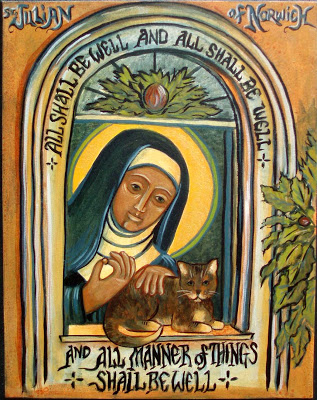
Living a spiritual life requires a change of heart, a conversion. Such a conversion may be marked by a sudden inner change, or it can take place through a long, quiet process of transformation. But it always involves an inner experience of oneness. We realize that we are in the center, and that from there all that is and all that takes place can be seen and understood as part of the mystery of God’s life with us. Our conflicts and pains, our tasks and promises, our families and friends, our activities and projects, our hopes and aspirations, no longer appear to us a fatiguing variety of things that we can barely keep together, but rather as affirmations and revelations of the new life of the Spirit in us. “All these other things,” which so occupied and preoccupied us, now come as gifts or challenges that strengthen and deepen the new life that we have discovered. This does not mean that the spiritual life makes things easier or takes our struggles and pains away. The lives of Jesus’ disciples clearly show that suffering does not diminish because of conversion. Sometimes it even becomes more intense. But our attention is no longer directed to the “more or less.” What matters is to listen attentively to the Spirit and to go obediently where we are being led, whether to a joyful or a painful place.
or coming back toward you.

(thank you, Deena)
Miserere mei, Deus: secundum magnam misericordiam tuam. Et secundum multitudinem miserationum tuarum, dele iniquitatem meam.
Henri Nouwen –
Forgiving does not mean forgetting. When we forgive a person, the memory of the wound might stay with us for a long time, even throughout our lives. Sometimes we carry the memory in our bodies as a visible sign. But forgiveness changes the way we remember. It converts the curse into a blessing. When we forgive our parents for their divorce, our children for their lack of attention, our friends for their unfaithfulness in crisis, our doctors for their ill advice, we no longer have to experience ourselves as the victims of events we had no control over.
Forgiveness allows us to claim our own power and not let these events destroy us; it enables them to become events that deepen the wisdom of our hearts. Forgiveness indeed heals memories.
Out beyond ideas of wrongdoing
and rightdoing there is a field.
I’ll meet you there. – Rumi
I go to this field most every day looking for the person who introduced me to this line of Rumi’s. And I’m alone.
I’ll continue to go.
Today the Anglican, Lutheran, and Roman Catholic Churches celebrate the Feast of the Conversion of St. Paul the Apostle. The same St. Paul, then called Saul, of whom it was said “Surely, this is the man who did such damage in Jerusalem…” The story of Saul’s conversion, found in Acts 9, is a remarkable story, a model of redemption. It gives me hope. It has shown me a path, a simple – and now familiar – path to recovery.
Simple, that is, once I got knocked off my high horse!
I, like Saul, once walked around with a grand sense of my own importance – big job, beautiful house, beautiful family, travel, clothes, cars…people who loved and admired me. I really was a somebody. There was one big problem, one major disconnection: I stopped working on my relationship with God. I stopped working at it and assumed that we were ok. We must have been ok…right? God had clearly shown me favor – I wanted for nothing.
In a similar way, I’d come to take my work for granted. And most egregiously, I’d taken relationships with close family and friends for granted.
I was living on hi-test ego. And like Saul, I defied subtlety. I heard the messages alright; I heard that voice and didn’t change, wouldn’t change. I was too proud and too full of my self. And that voice was so easy to disregard.
So God knocked me hard, hard enough to thoroughly disorient me, hard enough to knock me to the ground, hard enough to remove all the trappings of my self-importance, my self regard. I lost my sight. I couldn’t see where to go, didn’t know what to do.
Thankfully, I was given a simple message much like the message that Saul heard, “…you will be told what to do.” I found people who held me up and led me to a safe place where I could begin to recover my sight and learn to walk again – but now, as a humble student and servant. I, like Saul, took up residence at a place called Straight Street.
(The street exists today https://www.google.com/maps/place/Medhat+Basha+Souq/@33.507555,36.302731,16.63z/data=!4m5!3m4!1s0x1518e72a5e2d2ab9:0x16c3884e526c1b82!8m2!3d33.5086737!4d36.3051255 as Midhat Pasha Souq at its western end while the eastern end is called Bab Sharqi Street.)
Early on I came to know three things, as Saul (now Paul) had to learn:
Today I joyfully celebrate the Feast of the Conversion of St. Paul the Apostle.


 Edge of Atlantic