Today grant work to laborers, bread to the hungry, joy to the sorrowful,
— grace and redemption to all people.

Today grant work to laborers, bread to the hungry, joy to the sorrowful,
— grace and redemption to all people.
The truth is formed in silence and work and suffering – with which we become true. But we interfere with God’s work by talking too much about ourselves – even telling God what we ought to do – advising God how to make us perfect and listening for God’s voice to answer us with approval. We soon grow impatient and turn aside from the silence that disturbs us (the silence in which God’s work can best be done), and we invent the answer and the approval which will never come. Thomas Merton, journal entry November 12, 1952

Give us strength in temptation, endurance in trial, and gratitude in prosperity.
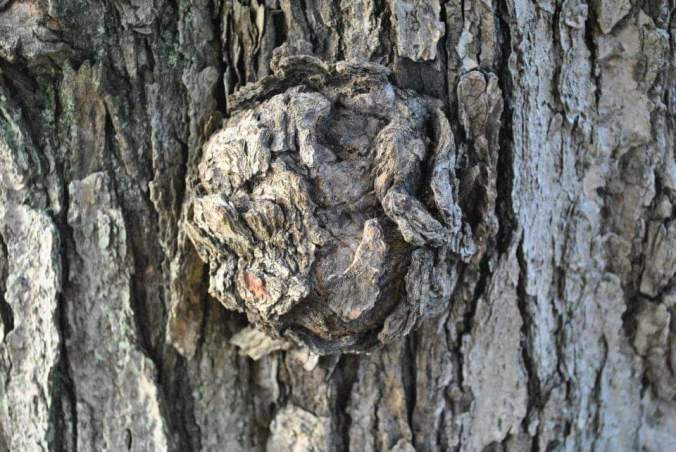
If you are bringing your gift to the altar, and there you remember that your brother or sister has something against you, leave your gift in front of the altar; go at once and make peace with your brother or sister, and then come back and offer your gift. (Matthew 5:23–24)

Photo by Pixabay on Pexels.com
If your brother sins, rebuke him;
and if he repents, forgive him.
And if he wrongs you seven times in one day
and returns to you seven times saying, ‘I am sorry,’
you should forgive him.” Luke 17:4

Photo: Mount Desert Island, ME – March 2018
Help us to spend this day in the spirit of joy.
 photo: Solvang, CA December 2017
I went out on the porch before dawn to think of these things, and the words of Ezekiel (22:30): “And I sought among them for a man that might set up a hedge and stand in the gap before me in favor of the land that I might not destroy it, and I found none.” And while I was standing there, quails began to whistle all over the field and in the wood. I had not heard any for weeks and thought sure they were all dead, for there have been hunters everywhere. No, there they are! Signs of life, of gentleness, of helplessness, of providence, of love. They just keep on existing and loving and making more quails and whistling in the bushes. – Thomas Merton, journal entry November 7, 1965
The house without a window is Hell:
to make a window is the foundation of true religion.
Don’t thrust your axe upon every thicket:
come, use your axe to cut open a window.
~ Rumi
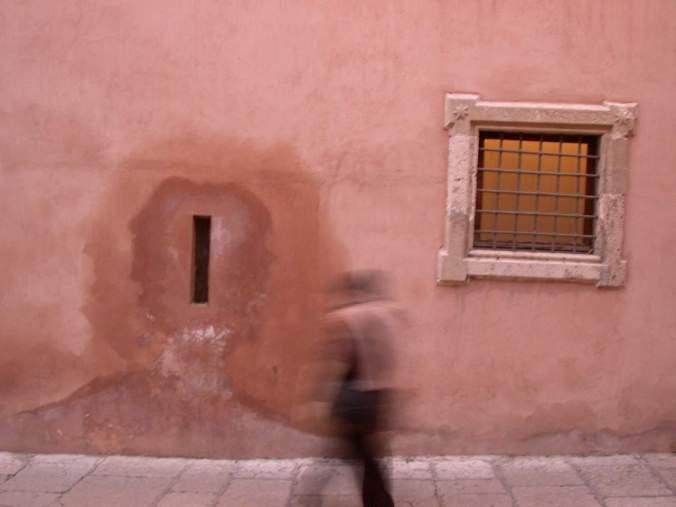
Photo: Assisi 2005
Fear, shame, and guilt often make us stay in our isolation and prevent us from realizing that our handicap, whatever it is, can always become the way to an intimate and healing fellowship in which we come to know one another as humans. After all, everyone shares the handicap of mortality. Our individual, physical, emotional, and spiritual failures are but symptoms of this disease. Only when we use these symptoms of mortality to form a fellowship of the weak can hope emerge. It is in the confession of our brokenness that the real strength of new and everlasting life can be affirmed and made visible. – Henri Nouwen
 Photo: Portland, ME – November 2017
Lead
Here is a story
to break your heart.
Are you willing?
This winter
the loons came to our harbor
and died, one by one,
of nothing we could see.
A friend told me
of one on the shore
that lifted its head and opened
the elegant beak and cried out
in the long, sweet savoring of its life
which, if you have heard it,
you know is a sacred thing,
and for which, if you have not heard it,
you had better hurry to where
they still sing.
And, believe me, tell no one
just where that is.
The next morning
this loon, speckled
and iridescent and with a plan
to fly home
to some hidden lake,
was dead on the shore.
I tell you this
to break your heart,
by which I mean only
that it break open and never close again
to the rest of the world.

 Edge of Atlantic