Love
if you offer
if you offer your food to the hungry
and satisfy the needs of the afflicted,
then your light shall rise in the darkness
and your gloom be like the noonday.
– Isaiah 58:10

Photo: Prout’s Neck, Maine – November 2016
love is not a doing
Love is not a doing but a state of being – a relatedness, a connectedness to another mortal, an identification with her or him that simply flows within me and through me, independent of my intentions or my efforts. – Robert A. Johnson
Looking for the key to the room of celebration
Christ came and declared a wedding feast, a celebration, at the very center of life. They crucified him not for being too ascetical, but because he told us that we might enjoy life. He told us that life will give us more goodness and enjoyment than we can stand, if we can learn to receive it without fear. But we are still in exile, without wedding garments, looking for the key to the room of celebration. Perhaps we need to be just a bit more earnest and sincere when we say the words, “your kingdom come!” – Ronald Rolheiser, Prayer: Our Deepest Longing
Christmas at Greccio
ST. BONAVENTURE TELLS THE STORY
It happened in the third year before his death, that in order to excite the inhabitants of Grecio to commemorate the nativity of the Infant Jesus with great devotion, [St. Francis] determined to keep it with all possible solemnity; and lest he should be accused of lightness or novelty, he asked and obtained the permission of the sovereign Pontiff. Then he prepared a manger, and brought hay, and an ox and an ass to the place appointed.
The brethren were summoned, the people ran together, the forest resounded with their voices, and that venerable night was made glorious by many and brilliant lights and sonorous psalms of praise.

The man of God [St. Francis] stood before the manger, full of devotion and piety, bathed in tears and radiant with joy; the Holy Gospel was chanted by Francis, the Levite of Christ. Then he preached to the people around the nativity of the poor King; and being unable to utter His name for the tenderness of His love, He called Him the Babe of Bethlehem.
Image: The Christmas celebration in the forest of Greccio | Giotto di Bondone | Fresco in the Upper Church of Saint Francis, Assisi | photo by The Yorck Project
From the Book of Isaiah the Prophet
But Zion said, “The Lord has forsaken me,
my Lord has forgotten me.”
Can a woman forget her nursing child,
or show no compassion for the child of her womb?
Even these may forget,
yet I will not forget you.
See, I have inscribed you on the palms of my hands;
your walls are continually before me.
Your builders outdo your destroyers,
and those who laid you waste go away from you.
Lift up your eyes all around and see;
they all gather, they come to you.
As I live, says the Lord,
you shall put all of them on like an ornament,
and like a bride you shall bind them on.
Surely your waste and your desolate places
and your devastated land—
surely now you will be too crowded for your inhabitants,
and those who swallowed you up will be far away.
The children born in the time of your bereavement
will yet say in your hearing:
“The place is too crowded for me;
make room for me to settle.”
Then you will say in your heart,
“Who has borne me these?
I was bereaved and barren,
exiled and put away—
so who has reared these?
I was left all alone—
where then have these come from?”
Isaiah 49:14-21

Photo: Siena, IT – January 2005 (yet I will not forget you./See, I have inscribed you on the palms of my hands.)
mercy within mercy within mercy
Thomas Merton entered Gethsemani monastery on December 10, 1941; he died while attending a monastic conference in Bangkok, Thailand, on December 10, 1968. In The Sign of Jonas, Merton wrote:
The voice of God is heard in Paradise: “What was vile has become precious. What is now precious was never vile. I have always known the vile as precious: for what is vile I know not at all. What was cruel has become merciful. What is now merciful was never cruel. I have always overshadowed Jonas with my mercy and cruelty I know not at all. Have you had sight of Me, Jonas, My child? Mercy within mercy within mercy. I have forgiven the universe without end, because I have never known sin. What was poor has become infinite. What is infinite was never poor. I have always known poverty as infinite: riches I love not at all. Prisons within prisons within prisons. Do not lay up for yourselves ecstasies upon earth, where time and space corrupt, where the minutes break in and steal. No more lay hold on time, Jonas, My son, lest the rivers bear you away. What was fragile has become powerful. I loved what was most frail. I looked upon what was nothing. I touched what was without substance and within what was not I AM.”
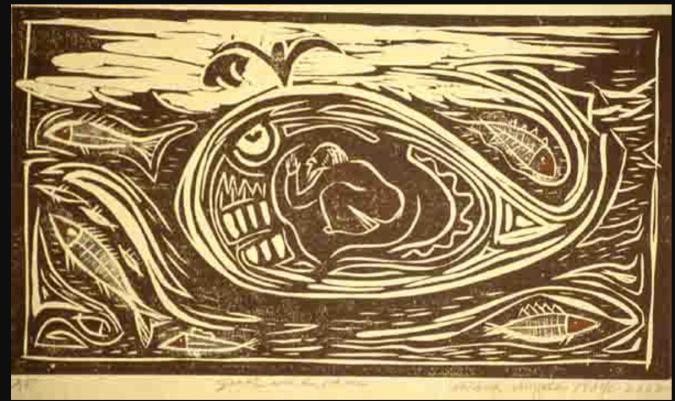
Print: “Jonah & the whale,” Mildred Nungester Wolfe (http://www.thewolfestudio.com/handmadereliefprints.htm)
maranatha
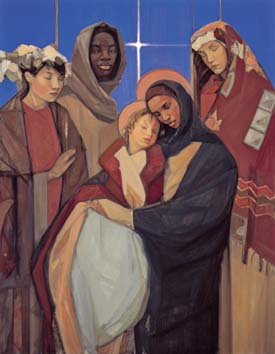
Come, Lord Jesus, of the people…
#732 – seasick
If you don’t become the ocean, you’ll be seasick every day. – Leonard Cohen
go at once and make peace
If you are bringing your gift to the altar, and there you remember that your brother or sister has something against you, leave your gift in front of the altar; go at once and make peace with your brother or sister, and then come back and offer your gift. (Matthew 5:23–24)

Photo by Pixabay on Pexels.com
 Edge of Atlantic