1095 (days) + 1@a time = 3
Love
We are the workers
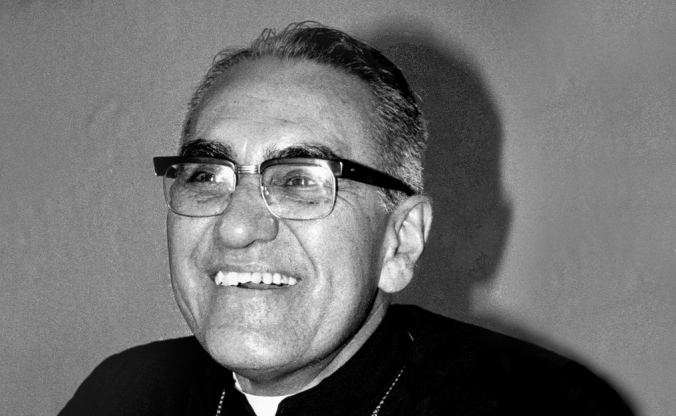 Aspire not to have more but to be more.
Defense of human rights, equality and freedom is a matter of policy rooted in the gospel.
Beautiful is the moment in which we understand that we are no more than an instrument of God; we live only as long as God wants us to live; we can only do as much as God makes us able to do; we are only as intelligent as God would have us be.
If we are worth anything, it is not because we have more money or more talent or more human qualities. Insofar as we are worth anything, it is because we are grafted on to Christ’s life, his cross and resurrection. That is a person’s measure.
We accomplish in our lifetime only a tiny fraction of the magnificent enterprise that is God’s work. Nothing we do is complete, which is a way of saying that the kingdom always lies beyond us. No statement says all that could be said. No prayer fully expresses our faith. No confession brings perfection. No pastoral visit brings wholeness. No program accomplishes the church’s mission. No set of goals and objectives includes everything.
This is what we are about. We plant the seeds that one day will grow. We water seeds already planted, knowing that they hold future promise. We lay foundations that will need further development. We provide yeast that produces far beyond our capabilities. we cannot do everything, and there is a sense of liberation in realizing that. this enables us to do something, and to do it very well. It may be incomplete, but it is a beginning, a step along the way, an opportunity for the Lord’s grace to enter and do the rest. We may never see the end results, but that is the difference between the master builder and the worker. We are the workers, not master builders; ministers, not messiahs.
– Archbishop Oscar Romero
To forgive is to put oneself in a larger gravitational field of experience…
Strangely, forgiveness never arises from the part of us that was actually wounded. The wounded self may be the part of us incapable of forgetting, and perhaps, not actually meant to forget, as if, like the foundational dynamics of the physiological immune system our psychological defenses must remember and organize against any future attacks — after all, the identity of the one who must forgive is actually founded on the very fact of having been wounded.
Stranger still, it is that wounded, branded, un-forgetting part of us that eventually makes forgiveness an act of compassion rather than one of simple forgetting. To forgive is to assume a larger identity than the person who was first hurt, to mature and bring to fruition an identity that can put its arm, not only around the afflicted one within but also around the memories seared within us by the original blow and through a kind of psychological virtuosity, extend our understanding to one who first delivered it.
Forgiveness is a skill, a way of preserving clarity, sanity and generosity in an individual life, a beautiful way of shaping the mind to a future we want for ourselves; an admittance that if forgiveness comes through understanding, and if understanding is just a matter of time and application then we might as well begin forgiving right at the beginning of any drama rather than put ourselves through the full cycle of festering, incapacitation, reluctant healing and eventual blessing.
To forgive is to put oneself in a larger gravitational field of experience than the one that first seemed to hurt us. We reimagine ourselves in the light of our maturity and we reimagine the past in the light of our new identity, we allow ourselves to be gifted by a story larger than the story that first hurt us and left us bereft.
– Richard Rohr

you are worth more than many sparrows
Are not five sparrows sold for two pennies? Yet not one of them is forgotten by God. Indeed, the very hairs of your head are all numbered. Don’t be afraid; you are worth more than many sparrows. – Luke 12:6-7
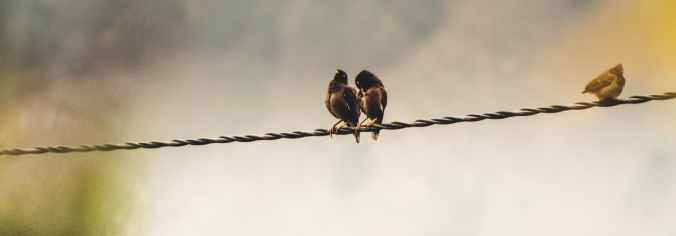
Photo by abhishek gaurav on Pexels.com
they just keep existing
I went out on the porch before dawn to think of these things, and of the words of Ezekiel (22:30): “And I sought among them for a man that might set up a hedge and stand in the gap before me in favor of the land that I might not destroy it, and I found none.” And while I was standing there, quails began to whistle all over the field and in the wood. I had not heard any for weeks and thought sure they were all dead, for there have been hunters everywhere. No, there they are! Signs of life, of gentleness, of helplessness, of providence, of love. They just keep existing and loving and making more quails and whistling in the bushes.
From Thomas Merton’s Journal – November 7, 1965

did you lack anything?
He said to them, “When I sent you out without a purse, bag, or sandals did you lack anything?” They said, “no, not a thing.”
– Luke 22:35
#1086

card #3

card #2


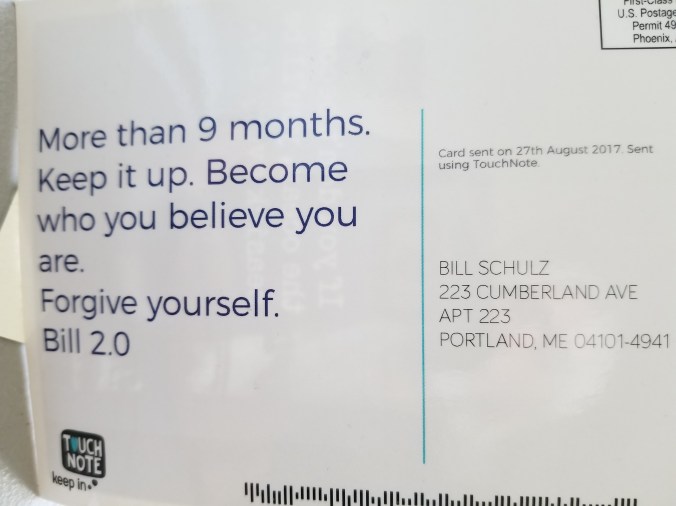
I sent cards to myself…
…in early recovery.
 Edge of Atlantic