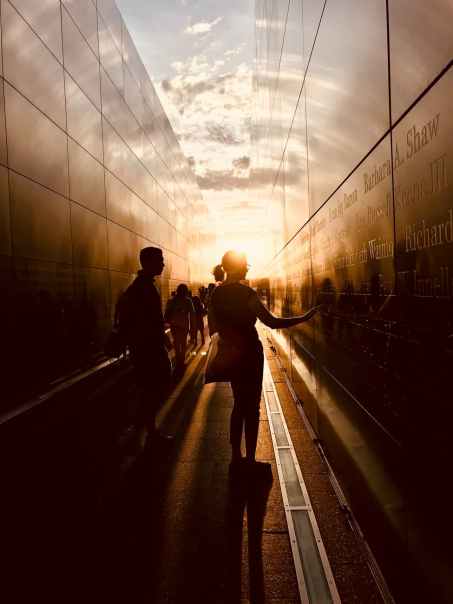
Photo by Tobe Roberts on Pexels.com
I / omen
What was going on in the New York American
Black/red/green helmeted neon night?
The elevator door was closing behind us, we were the ones
Plunging floor after floor after floor after floor
To the abyss—but it was someone else’s face
Staring from the screen out at us, someone else’s face
Saying something flashing from the teleprompter:
Though what the face said was meant to reassure,
Down in the abyss the footage kept playing,
All of it looping back like children chanting
The answers to nonsensical riddles, taunting
A classmate who doesn’t know the question:
“Because it’s too far to walk” “Time to get a new fence”
“A big red rock eater.” And as the images rewound
And the face kept talking, the clear night sky
Filled up with smoke and the smoke kept puring
Itself out into the air like a voice saying something
It can’t stop saying, some murky omen
Like schoolkids asking: “Why do birds fly south?”
“What time is it when an elephant sits on the fence?”
“What’s big, red and eats rocks?”
2 / in front of st. vincent’s
A woman hugging another woman
Who was weeping blocked the sidewalk.
Nobody moved for a moment.
They were an island caught at the tide turning:
Such misery in two human bodies.
Then the wearing away of the crowd
Moving flowed over them and they
Were pulled swiftly along down the sidewalk.
3 / joke
Faces powdered with dust and ash, there they were
In the fast food place, raucous and wild, splitting
The seams of their work clothes, weary to hysteria
As they hunched in their booth next to the buffet
Under heat lamps reflecting incarnadine
Off pastas and vegetable slag. Then the joke
Ignited, they quivered on the launch pad,
Laughter closed around them, they couldn’t
Breathe, it was as if they were staring out
From a space capsule porthole and were asking
The void an imponderable riddle
While orbiting so high up in space
That the earth was less than the least hint
Of light piercing the smoke-filled, cloudless night.
(What was the joke about? Nobody knew.)
And then they stopped laughing and stared into their plates,
Ash smearing down their faces as they chewed.
4 / spell spoken by suppliant to helios for knowledge
from the Greek Magical Papyri
Under my tongue is the mud of the Nile,
I wear the baboon hide of sacred Keph.
Dressed in the god’s power, I am the god,
I am Thouth, discoverer of healing drugs,
Founder of letters. As god calls on god
I summon you to come to me, you
Under the earth; arouse yourself for me,
Great daimon, you the subterranean,
You of the primordial abyss.
Unless you tell me what I want to know,
What is in the minds of everyone, Egyptians,
Greeks, Syrians, Ethiopians, of every race
And people, unless I know what has been
And what shall be, unless I know their skills
And practices and works and lives and names
Of them and their fathers and mothers
And brothers and friends, even of those now dead,
I will pour the blood of the black-faced jackal
As an offering in a new-made jar and put it
In the fire and burn beneath it what’s left
Of the bones of all-praised Osiris,
And I will shout in the port of Busiris
The secrets of his mysteries, that his body,
Drowned, remained in the river three days
And three nights, that he, the praised one,
Was carried by the river into the sea
And surrounded by wave on wave on wave
And by mist rising off water through the air.
To keep your belly from being eaten by fish,
To keep the fish from chewing your flesh with their mouths,
To make the fish close their hungry jaws, to keep
The fatherless child from being taken
From his mother, to keep the pole of the sky
From being brought down and the twin towering
Mountains from toppling into one, to keep Anoixis
From running amok and doing just what she wants,
Not god or goddess will give oracles
Until I know through and through
Just what is in the minds of all human beings,
Egyptians, Syrians, Greeks, Ethyopians, of every race
And people, so that those who come to me.
Their eyes and mine can meet in a level gaze,
Neither one or the other higher or lower,
And whether they speak or keep silent,
I can tell them whatever has happened
And is happening and is going to happen
To them, and I can tell them their skills
And their works and their names and those of their dead,
And of every human being who comes to me
I will read them as I read a sealed letter
And tell them everything truthfully.
5 / from brooklyn bridge
Sun shines on the third bridge tower:
A garbage scow ploughs the water,
Maternal hull pushing is all out beyond
The city, pushing it all out so patiently—
All you could hear out there this flawless afternoon
Is the sound of sand pulverizing newsprint
To tatters, paper-pulp ripping crosswise
Or lengthwise, shearing off some photo
Of maybe a head or maybe an arm.
Ridiculous flimsy noble newspaper,
Leaping in wind, fluttering, collapsing,
Its columns sway and topple into babble:
All you’d see if you were out there
Is air vanishing into clearer air.
6 / from the plane
Pressed against our seats, them released to air,
From the little plane windows we peered four thousand feet
Down to the ground desert-gray and still,
Nothing seeming to be moving on that perfect afternoon,
No reminder of why it was we were all looking,
Remembering maybe the oh so flimsy
Wooden sawhorse police barricades, as the woman
In front of me twisted her head back to see
It all again, but up there there was nothing to see,
Only the reef water feel of transparency
Deepening down to a depth where everything
Goes dark and nothing moves unless it belongs
To that dark, darting in and out or undulating
Slowly or cruising unblinking, jaws open or closed.
7 / spell broken by suppliant to helios for protection
from the Greek Magical Papyri
This is the charm that will protect you, the charm
That you must wear: Onto lime wood write
With vermilion the secret name, name of
The fifty magic letters. Then say the words:
“Guard me from every daimon of the air,
On the earth and under the earth, guard me
From every angel and phantom, every
Ghostly visitation and enchantment,
Me, your suppliant.” Enclose it in a skin
Dyed purple, hang it round your neck and wear it.
8 / roll of film: photographer missing
Vines of smoke through latticework of steel
Weave the air into a garden of smoke.
And in the garden people came and went,
People of smoke and people of flesh, the air dressed
In ash. What the pictures couldn’t say
Was spoken by the smoke: A common language
In a tongue of smoke that murmured in every ear
Something about what it was they’d been forced
To endure: Words spoken in duress,
Inconsolable words, words spoken under the earth
That rooted in smoke and breathed in the smoke
And put forth shoots that twined through the steel,
Words plunged through the roof of the garages’
Voids, I-beams twisted; the eye that saw all this
Tells and tells again one part of the story
Of that day of wandering through the fatal garden,
The camera’s eye open and acutely
Recording in the foul-smelling air.
9 / lamentation on ur
from a Sumerian spell, 2000 B.C.
Like molten bronze and iron shed blood
pools. Our country’s dead
melt into the earth
as grease melts in the sun, men whose
helmets now lie scattered, men annihilated
by the double-bladed axe. Heavy, beyond
help, they lie still as a gazelle
exhausted in a trap,
muzzle in the dust. In home
after home, empty doorways frame the absence
of mothers and fathers who vanished
in the flames remorselessly
spreading claiming even
frightened children who lay quiet
in their mother’s arms, now borne into
oblivion, like swimmers swept out to sea
by the surging current.
May the great barred gate
of blackest night again swing shut
on silent hinges. Destroyed in its turn,
may this disaster too be torn out of mind.
Tom Sleigh, “New York American Spell” from Far Side of the Earth. Copyright © 2003, by Tom Sleigh.


 Edge of Atlantic