the true self

The false self is your psychological creation of yourself in space and time. It comes from your early conditioning, family, roles, education, mind, culture, and religion. The false self is who you think you are! But thinking doesn’t make it so. The false self dies and passes away. Yet it is the raw material through which you discover your True Self in God, so you must not hate it or kill it. Just learn from it. Of itself, it does not know how to pray, because it does not understand simple presence, communion, or relationship. The false self is all about utility and “What can I get out of this?” Not bad, but very incomplete.

The True Self is not created by anything you have done right or wrong. Nor can you lose it by doing anything good or bad. The True Self is not formed by adhering to any requirements; it’s about relationship itself—the quality and capacity for connection. Only the True Self can pray. The false self will say prayers but the True Self is a prayer and looks out at reality from a different pair of eyes larger than its own. This is why in Ephesians it can say “pray always” (6:18). We pray always whenever we act in conscious and loving union with things—which eventually can be all the time. Then whatever you do is a prayer, not a recited prayer but a full-bodied, bigger-than-mind, contemplative prayer. When you are in your True Self, your prayer and your breath are the same thing.
– R. Rohr
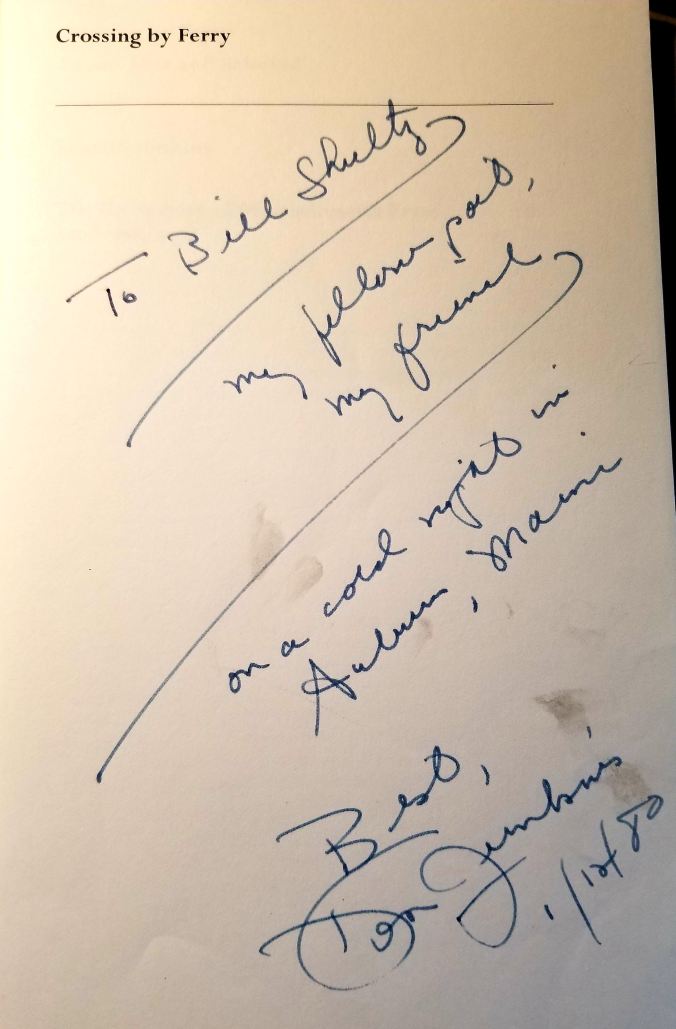
Approaches to Blue Hill Bay: Chart No. 13313 – Donald Junkins

Late June, walking the deer runs
to Goose Pond after supper,
summer begins. Sidestepping
stormblown poplars,
dry-wading the slash from the pulper’s camps
ten years ago, keeping the imaginary
straight line from Duck Island Light to the  north side
of Goose Pond Mountain in our minds’ eyes, poking
straight-arms, trying to keep from snagging
the green fur, the purple stars in the schooldesk landscape
of the nautical chart.
Yellow, blue.
The island woods are yellow. The evening sun
sprays through from the other side of the evergreens.
Watercolors, our first grade pegs
arranging. We push for the first view
of the marsh-edged shore, spruce stumpsticks
edging deep water trout
neverminding the cold. We know where we are:
a mile straight in on the yellow.
We lose our way. My son climbs a blue spruce
to see where we’ve been: the two Sisters,
Long Island Plantation. On the left, the Baptist
church in Atlantic. We head into the sun.
Late June, walking the deer runs
to Goose Pond after supper,
summer begins suddenly. We can hear
the creeing of gulls. Beyond the trees
they are landing, taking off, landing.
Saltwhite. Freshblue. It is all
prearranged. In a minute now
we will see the pond. Nothing has changed.

Donald Junkins, The New Yorker, June 1977

20190821_141931 (1)

blessings

Presently the two mares and the two colts came over to see me and to take a drink. The colts looked like children with their big grave eyes, very humble…and they were tamer than I expected. They came over and nudged me with their soft muzzles and I talked to them a bit.  – Thomas Merton


A Blessing – James Wright

Just off the highway to Rochester, Minnesota,
Twilight bounds softly forth on the grass.
And the eyes of those two Indian ponies
Darken with kindness.
They have come gladly out of the willows
To welcome my friend and me.
We step over the barbed wire into the pasture
Where they have been grazing all day, alone.
They ripple tensely, they can hardly contain their happiness
That we have come.
They bow shyly as wet swans. They love each other.
There is no loneliness like theirs.
At home once more,
They begin munching the young tufts of spring in the darkness.
I would like to hold the slenderer one in my arms,
For she has walked over to me
And nuzzled my left hand.
She is black and white,
Her mane falls wild on her forehead,
And the light breeze moves me to caress her long ear
That is delicate as the skin over a girl’s wrist.
Suddenly I realize
That if I stepped out of my body I would break
Into blossom.
(James Wright, “A Blessing” from Above the River: The Complete Poems and Selected Prose.Copyright 1990 by James Wright. Reprinted by permission of Wesleyan University Press.)

horses grazing

Photo by Tomasz Filipek on Pexels.com

August Prayer

IMG_1007
This morning I give thanks
for breath
for breathing
I give thanks for
open windows and
French doors half-opened
and half-shut

This morning I give thanks
for clear glass tumblers
of cold Sebago water
and the crickets
of course and the crows
thanks for the cool
wash cloth

the comfort of hands
thanks for the taste of lemon
and the hair brush
this morning
I give thanks
for the shadow
that lingers a moment

then leaves the world

(photo: Portland, Maine – August 2014)

Recall the joy of discovery

To keep the spirit of eternal youth active in us during the second half of life, we must learn again to play with our experience. Recall the joy of discovery before it bowed to work, obligation, and duty. Movement is alive; inertia is dead. We become more “unalive” as we cling to that which is predictable and unchanging. Enthusiasm is closely related to the spirit of play – the word comes from the ancient Greek theos, meaning “god.” To have enthusiasm is to allow yourself to be filled with divine assistance, so the ego does not need to handle your tasks by itself.
Robert A. Johnson, from Living Your Unlived Life


Happy 85th Birthday, Wendell Berry

Image result for wendell berry
The Peace of Wild Things
BY WENDELL BERRY

When despair for the world grows in me
and I wake in the night at the least sound
in fear of what my life and my children’s lives may be,
I go and lie down where the wood drake
rests in his beauty on the water, and the great heron feeds.
I come into the peace of wild things
who do not tax their lives with forethought
of grief. I come into the presence of still water.
And I feel above me the day-blind stars
waiting with their light. For a time
I rest in the grace of the world, and am free.

The reality of now

The grip the present has on me. That is the one thing that has grown most noticeably in the spiritual life – nothing much else has. The rest dims as it should. I am getting older. The reality of now – the unreality of the rest. The unreality of ideas and explanations and formulas. I am. The unreality of all the rest. The pigs shriek. Butterflies dance together against the blue sky at the end of the woodshed. The buzz saw stands outside there, half covered with dirty and tattered canvas. The trees are fresh and green in the sun (more rain yesterday). Small clouds, inexpressibly beautiful and silent and eloquent, over the silent woodlands. What a celebration of light, quietness, and glory! This is my feast, sitting here in the straw!
– Thomas Merton, journal entry – August 25, 1958

DSC_7743

(photo: Runaround Pond, Maine – June 2019)

Keeping Quiet – Pablo Neruda

Image result for pablo neruda
Now we will count to twelve
and we will all keep still.

For once on the face of the earth,
let’s not speak in any language;
let’s stop for one second,
and not move our arms so much.

It would be an exotic moment
without rush, without engines;
we would all be together
in a sudden strangeness.

Fisherman in the cold sea
would not harm whales
and the man gathering salt
would look at his hurt hands.

Those who prepare green wars,
wars with gas, wars with fire,
victories with no survivors,
would put on clean clothes
and walk about with their brothers
in the shade, doing nothing.

What I want should not be confused
with total inactivity.
Life is what it is about;
I want no truck with death.

If we were not so single-minded
about keeping our lives moving,
and for once could do nothing,
perhaps a huge silence
might interrupt this sadness
of never understanding ourselves
and of threatening ourselves with death.
Perhaps the earth can teach us
as when everything seems dead
and later proves to be alive.

Now I’ll count up to twelve
and you keep quiet and I will go.

a book open to the sky

I don’t think it is enough appreciated how much an outdoor book the Bible is. It is a ‘hypaethral book,’ such as Thoreau talked about – a book open to the sky. It is best read and understood outdoors, and the farther outdoors the better. Or that has been my experience of it. Passages that within walls seem improbable or incredible, outdoors seem merely natural. This is because outdoors we are confronted everywhere with wonders; we see that the miraculous is not extraordinary but the common mode of existence. It is our daily bread. Whoever really has considered the lilies of the field or the birds of the air and pondered the improbability of their existence in this warm world within the cold and empty stellar distances will hardly balk at the turning of water into wine – which was, after all, a very small miracle. We forget the greater and still continuing miracle by which water (with soil and sunlight) is turned into grapes.
Wendell Berry, “Christianity and the Survival of Creation” in Sex, Economy, Freedom & Community