now I understand – the path to healing

Ronald Rolheiser – In his last book, The Living Flame of Love, John (St. John of the Cross) proposes a theory of, and a process for, healing. In essence, it runs this way: For John, we heal of our wounds, moral flaws, addictions, and bad habits by growing our virtues to the point where we become mature enough in our humanity so that there’s no more room left in our lives for the old behaviors that used to drag us down. In short, we get rid of the coldness, bitterness, and pettiness in our hearts by lighting inside our hearts enough warm fires to burn out the coldness and bitterness.

The algebra works this way: The more we grow in maturity, generativity, and generosity, the more our old wounds, bad habits, temperamental flaws, and addictions will disappear because our deeper maturity will no longer leave room for them in our lives. Positive growth of our hearts, like a vigorous plant, eventually chokes-out the weeds. If you went to John of the Cross and asked him to help you deal with a certain bad habit in your life, his focus wouldn’t be on how to weed-out that habit. Instead the focus would be on growing your virtues: What are you doing well? What are your best qualities? What goodness in you needs to be fanned fan into fuller flame?

By growing what’s positive in us, we eventually become big-hearted enough so that there’s no room left for our former bad habits. The path to healing is to water our virtues so that these virtues themselves will be the fire that burns out the festering wounds, addictions, bad habits, and temperamental flaws that have, for far too long, plagued our lives and kept us wallowing in weakness and pettiness rather than walking in maturity, generosity, and generativity.

beyond words…beyond names

DSC_6975Prayer is what you bring – for prayer is your gift to us rather than what you ask of us. If only I could pray – and yet I can and do pray. Teach me to go to the country beyond words and beyond names. Teach me to pray on this side of the frontier, here where the woods are.   – Thomas Merton, Journal July 17, 1956

Thanks – W.S. Merwin

Listen
with the night falling we are saying thank you
we are stopping on the bridges to bow from the railings
we are running out of the glass rooms
with our mouths full of food to look at the sky
and say thank you
we are standing by the water thanking it
standing by the windows looking out
in our directions

back from a series of hospitals back from a mugging
after funerals we are saying thank you
after the news of the dead
whether or not we knew them we are saying thank you

over telephones we are saying thank you
in doorways and in the backs of cars and in elevators
remembering wars and the police at the door
and the beatings on stairs we are saying thank you
in the banks we are saying thank you
in the faces of the officials and the rich
and of all who will never change
we go on saying thank you thank you

with the animals dying around us
taking our feelings we are saying thank you
with the forests falling faster than the minutes
of our lives we are saying thank you
with the words going out like cells of a brain
with the cities growing over us
we are saying thank you faster and faster
with nobody listening we are saying thank you
thank you we are saying and waving
dark though it is

W.S. Merwin, “Thanks” from Migration: New and Selected Poems. Copyright © 2005 by W.S. Merwin.  Reprinted by permission of The Wylie Agency, Inc..

Mercy within mercy within mercy

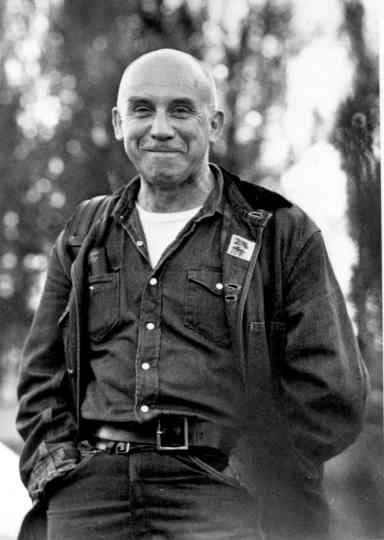
Thomas Merton full

The Voice of God is heard in Paradise:
“What was vile has become precious. What is now precious was never vile. I have always known the vile as precious: for what is vile I know not at all.
“What was cruel has become merciful. What is now merciful was never cruel. I have always overshadowed Jonas with my mercy, and cruelty I know not at all. Have you had sight of Me, Jonas, my child? Mercy within mercy within mercy. I have forgiven the universe without end, because I have never known sin.
“What was poor has become infinite. What is infinite was never poor. I have always known poverty as infinite: riches I love not at all. Prisons within prisons within prisons. Do not lay up for yourself ecstasies upon earth, where time and space corrupt, where minutes break in and steal. No more lay hold on time, Jonas, my son, lest the rivers bear you away.
“What was fragile has become powerful. I loved what was most frail. I looked upon what was nothing. I touched what was without substance, and within what was not, I am.”

There are drops of dew that show like sapphires in the grass as soon as the morning sun appears, and leaves stir behind the hushed flight of an escaping dove.

– Thomas Merton, Journal, July 4, 1952


and not only that…

And not only that, but we also boast in our sufferings, knowing that suffering produces endurance, and endurance produces character, and character produces hope, and hope does not disappoint us, because God’s love has been poured into our hearts through the Holy Spirit that has been given to us. – Romans 5:3-5

DSC_7033

waking up

The conviction that I have not even begun to write, to think, to pray, and to live, and that only now am I getting down to waking up. And that, by God’s grace, this comes from finally trying, with great difficulty, to be genuinely free and alone, as humbly as I can, in God’s sight, without passively accepting all the standards and the formulas which have been adopted by others – or, at least, that I am now exercising a wider choice in my sources of inspiration.   – Thomas Merton, journal entry June 22, 1958

DSC_6542