If it were possible for us to see further than our knowledge reaches, and a little beyond the outworks of our intuitions, perhaps we should then bear our sadnesses with greater assurance than our joys. For they are the moments when something new enters into us, something unknown to us; our feelings, shy and inhibited, fall silent, everything in us withdraws, a stillness settles on us, and at the centre of it is the new presence that nobody yet knows, making no sound.
With great difficulty advancing by millimetres each year, I carve a road out of the rock. For millenniums my teeth have wasted and my nails broken to get there, to the other side, to the light and the open air. And now that my hands bleed and my teeth tremble, unsure in a cavity cracked by thirst and dust, I pause and contemplate my work. I have spent the second part of my life breaking the stones, drilling the walls, smashing the doors, removing the obstacles I placed between the light and myself in the first part of my life.
The kings of the world are growing old, and they shall have no inheritors. Their sons died while they were boys, and their neurasthenic daughters abandoned the sick crown to the mob.
The mob breaks it into tiny bits of gold. The Lord of the World, master of the age, melts them in fire into machines, which do his orders with low growls; but luck is not on their side.
The ore feels homesick. It wants to abandon the minting houses and the wheels that offer it such a meager life. And out of factories and payroll boxes it wants to go back into the veins of the thrown-open mountain, which will close again behind it.
When we contemplate the fall of empires and the extinction of nations of the ancient world, we see but little to excite our regret than the moldering ruins of pompous palaces, magnificent monuments, lofty pyramids, and walls and towers of the most costly workmanship. But when the empire of America shall fall, the subject for contemplative sorrow will be infinitely greater than crumbling brass or marble can inspire. It will not then be said, Here stood a temple of vast antiquity; here rose a Babel of invisible height; or there a palace of sumptuous extravagance; but here, ah painful thought! the noblest work of human wisdom, the grandest scene of human glory, the fair cause of freedom rose and fell!
Abba Anthony said, “A time is coming when men will go mad, and when they see someone who is not mad, they will attack him saying, ‘You are mad, you are not like us.'”
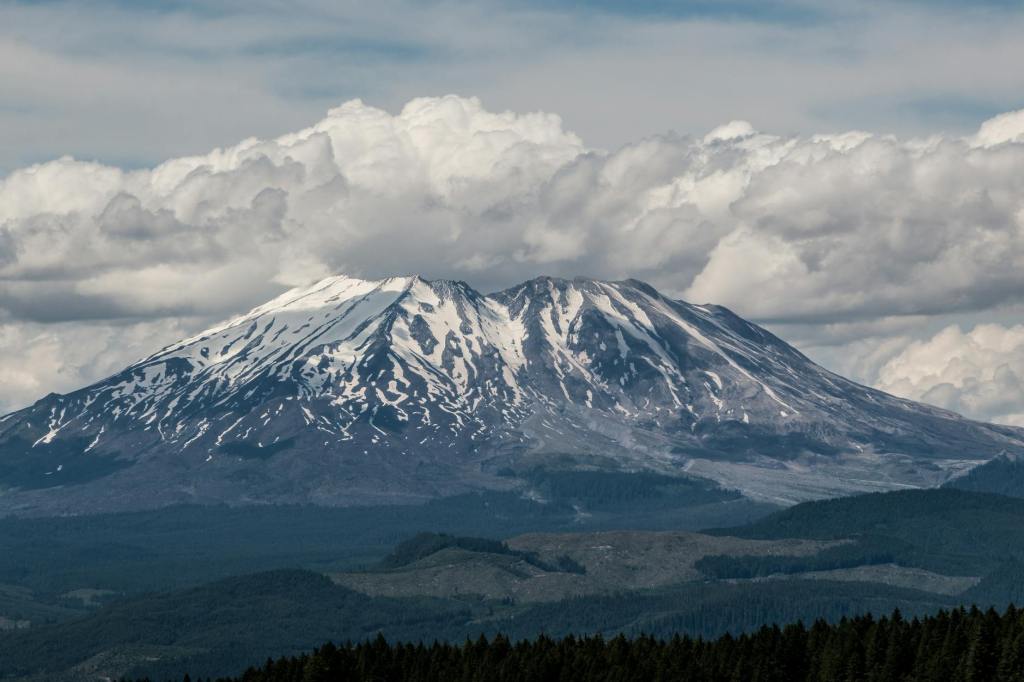
The day I first climbed Mt. St. Helens was August 13, 1945.
Spirit Lake was far from the cities of the valley and news came slow. Though the first atomic bomb was dropped on Hiroshima August 6 and the second dropped on Nagasaki August 9, photographs didn’t appear in the Portland Oregonian until August 12. Those papers must have been driven in to Spirit Lake on the 13th. Early the morning of the 14th I walked over to the lodge to check the bulletin board. There were whole pages of the paper pinned up: photos of a blasted city from the air, the estimate of 150,000 dead in Hiroshima alone, the American scientist quoted saying “nothing will grow there again for seventy years.” The morning sun on my shoulders, the fir forest smell and the big tree shadows; feet in thin moccasins feeling the ground, and my heart still one with the snowpeak mountain at my back. Horrified, blaming scientists and politicians and the governments of the world, I swore a vow to myself, something like, “By the purity and beauty and permanence of Mt. St. Helens, I will fight against this cruel destructive power and those who would seek to use it, for all my life.”
There are dogs and dogs. I was among the chosen. I had good papers and wolf’s blood in my veins. I lived upon the heights inhaling the odors of views: meadows in sunlight, spruces after rain, and clumps of earth beneath the snow.
I had a decent home and people on call, I was fed, washed, groomed, and taken for lovely strolls. Respectfully, though, and comme il faut. They all knew full well whose dog I was.
Any lousy mutt can have a master. Take care, though — beware comparisons. My master was a breed apart. He had a splendid herd that trailed his every step and fixed its eyes on him in fearful awe.
For me they always had smiles, with envy poorly hidden. Since only I had the right to greet him with nimble leaps, only I could say good-bye by worrying his trousers with my teeth. Only I was permitted to receive scratching and stroking with my head laid in his lap. Only I could feign sleep while he bent over me to whisper something.
He raged at others often, loudly. He snarled, barked, raced from wall to wall. I suspect he liked only me and nobody else, ever.
I also had responsibilities: waiting, trusting. Since he would turn up briefly, and then vanish. What kept him down there in the lowlands, I don’t know. I guessed, though, it must be pressing business, at least as pressing as my battle with the cats and everything that moves for no good reason.
There’s fate and fate. Mine changed abruptly. One spring came and he wasn’t there. All hell broke loose at home. Suitcases, chests, trunks crammed into cars. The wheels squealed tearing downhill and fell silent round the bend.
On the terrace scraps and tatters flamed, yellow shirts, armbands with black emblems and lots and lots of battered cartons with little banners tumbling out.
I tossed and turned in this whirlwind, more amazed than peeved. I felt unfriendly glances on my fur. As if I were a dog without a master, some pushy stray chased downstairs with a broom.
Someone tore my silver-trimmed collar off, someone kicked my bowl, empty for days. Then someone else, driving away, leaned out from the car and shot me twice.
He couldn’t even shoot straight, since I died for a long time, in pain, to the buzz of impertinent flies. I, the dog of my master.
I have learned that an age in which politicians talk about peace is an age in which everybody expects war: the great men of the earth would not talk of peace so much if they did not secretly believe it possible, with one more war, to annihilate their enemies forever. Always, “after just one more war” it will dawn, the new era of love: but first everybody who is hated must be eliminated. For hate, you see, is the mother of their kind of love.
Unfortunately the love that is to be born out of hate will never be born. Hatred is sterile; it breeds nothing but the image of its own empty fury, its own nothingness. Love cannot come of emptiness. It is full of reality. Hatred destroys the real being of man in fighting the fiction which it calls “the enemy.” For man is concrete and alive, but “the enemy” is a subjective abstraction. A society that kills real men in order to deliver itself from the phantasm of a paranoid delusion is already possessed by the demon of destructiveness because it has made itself incapable of love. It refuses, a priori, to love. It is dedicated not to concrete relations of man with man, but only to abstractions about politics, economics, psychology, and even, sometimes, religion.


 Edge of Atlantic