The kings of the world are growing old, and they shall have no inheritors. Their sons died while they were boys, and their neurasthenic daughters abandoned the sick crown to the mob.
The mob breaks it into tiny bits of gold. The Lord of the World, master of the age, melts them in fire into machines, which do his orders with low growls; but luck is not on their side.
The ore feels homesick. It wants to abandon the minting houses and the wheels that offer it such a meager life. And out of factories and payroll boxes it wants to go back into the veins of the thrown-open mountain, which will close again behind it.
Abba Anthony said, “A time is coming when men will go mad, and when they see someone who is not mad, they will attack him saying, ‘You are mad, you are not like us.'”
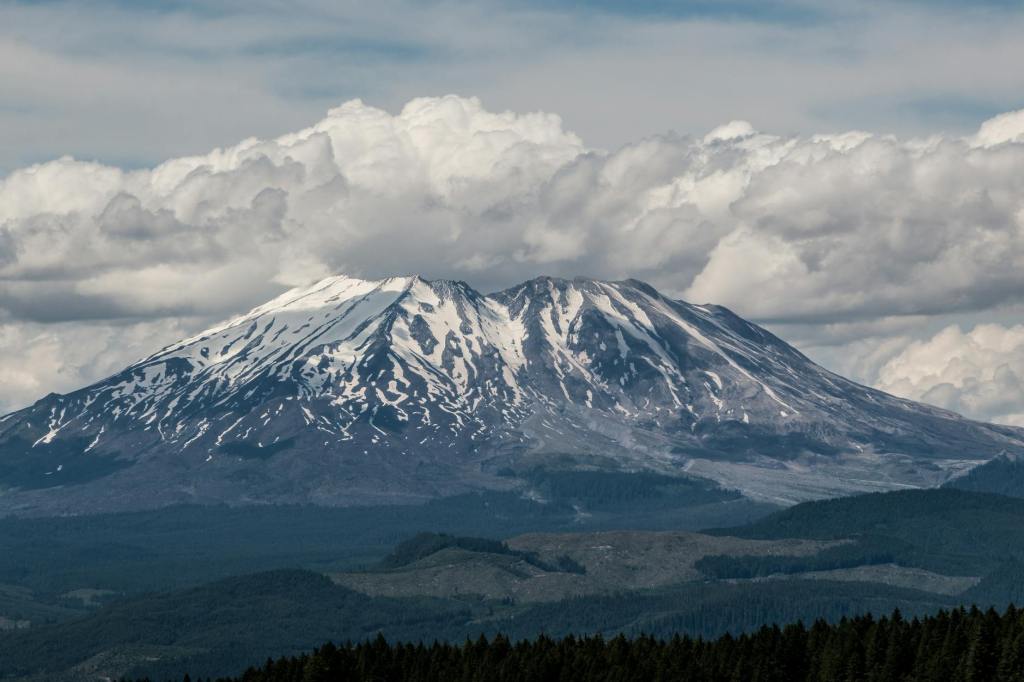
The day I first climbed Mt. St. Helens was August 13, 1945.
Spirit Lake was far from the cities of the valley and news came slow. Though the first atomic bomb was dropped on Hiroshima August 6 and the second dropped on Nagasaki August 9, photographs didn’t appear in the Portland Oregonian until August 12. Those papers must have been driven in to Spirit Lake on the 13th. Early the morning of the 14th I walked over to the lodge to check the bulletin board. There were whole pages of the paper pinned up: photos of a blasted city from the air, the estimate of 150,000 dead in Hiroshima alone, the American scientist quoted saying “nothing will grow there again for seventy years.” The morning sun on my shoulders, the fir forest smell and the big tree shadows; feet in thin moccasins feeling the ground, and my heart still one with the snowpeak mountain at my back. Horrified, blaming scientists and politicians and the governments of the world, I swore a vow to myself, something like, “By the purity and beauty and permanence of Mt. St. Helens, I will fight against this cruel destructive power and those who would seek to use it, for all my life.”
The rush and pressure of modern life is a form, perhaps the most common form, of its innate violence. To allow oneself…to surrender to too many demands, to commit oneself to too many projects, to want to help everyone in everything, is to succumb to violence. More than that, it is cooperation in violence.
– Thomas Merton, Conjectures of a Guilty Bystander
I have learned that an age in which politicians talk about peace is an age in which everybody expects war: the great men of the earth would not talk of peace so much if they did not secretly believe it possible, with one more war, to annihilate their enemies forever. Always, “after just one more war” it will dawn, the new era of love: but first everybody who is hated must be eliminated. For hate, you see, is the mother of their kind of love.
Unfortunately the love that is to be born out of hate will never be born. Hatred is sterile; it breeds nothing but the image of its own empty fury, its own nothingness. Love cannot come of emptiness. It is full of reality. Hatred destroys the real being of man in fighting the fiction which it calls “the enemy.” For man is concrete and alive, but “the enemy” is a subjective abstraction. A society that kills real men in order to deliver itself from the phantasm of a paranoid delusion is already possessed by the demon of destructiveness because it has made itself incapable of love. It refuses, a priori, to love. It is dedicated not to concrete relations of man with man, but only to abstractions about politics, economics, psychology, and even, sometimes, religion.
Thus we became highly disciplined, organized, and rational on one side, but the other side remained a suppressed primitive, cut off from education and civilization.
This explains our many relapses into the most appalling barbarity, and it also explains the really terrible fact that, the higher we climb the mountain of scientific and technical achievement, the more dangerous and diabolical becomes the misuse of our inventions. Think of the great triumph of the human mind, the power to fly: we have accomplished the age-old dream of humanity! And think of the bombing raids of modern warfare! Is this what civilization means? Is it not rather a convincing demonstration of the fact that, when our mind went up to conquer the skies, our other man, that suppressed barbarous individual, went down to hell? Certainly our civilization can be proud of its achievements, yet we have to be ashamed of ourselves. – Carl Jung, from Psychology and the East
The gregarious And mild-tempered never know Each other by name: Creatures who make friends are shy And liable to anger. * Unable to see A neighbor to frown at, Eutroplus beat his wife. (after K. Lorenz) * A dead man Who never caused others to die Seldom rates a statue. * Small tyrants, threatened by big, Sincerely believe They love Liberty. * Tyrants may get killed, But their hangmen usually Die in their beds. * Patriots? Little boys Obsessed by bigness, Big pricks, big money, big bangs. * He praised his God For the expertise Of his torturer and his chef. * Reluctant at first To break his sworn promise Of Safe Conduct, after Consulting his confessor, In good spirits He signed a death-warrant. * “Be godly,” he told his flock, “Bloody and extreme Like the Holy Ghost.” * After the massacre, They pacified their conscience By telling jokes. * When their Infidel Paymaster fell in arrears, The mercenaries Recalled their unstained childhoods In devout Christian homes. * With silver mines, Recruiting grounds, A general of real genius, He thought himself invulnerable: In one battle He lost all three. * The last king Of a fallen dynasty Is never well spoken of. * Intelligent, rich, Humane, the young man dreamed of Posthumous glory As connoisseur and patron Of Scholarship and the Arts. An age bent on war, The ambitions of his king, Decreed otherwise: He was to be remembered As a destroyer of towns. * Born to flirt and write light verses, He died bravely By the headsman’s axe. * Into the prosperous quiet Between two wars Came Anopheles. * The Queen fled, leaving Books behind her That shocked the pious usurper. * Assembling With ceremonial pomp, The Imperial Diet Cravely debated Legislation It had no power to reject. * Victorious over The foreign tyrant, The patriots retained His emergency Police regulations, Devised to suppress them. * In States unable To alleviate Distress, Discontent is hanged. * In semi-literate countries Demagogues pay Court to teen-agers. * To maintain a stud Of polo ponies he now Was too stout to ride, He slapped taxes on windows, Hearth-stones and door-steps and wives. * He walked like someone Who’d never had to Open a door for himself. * Abandoning his wives, He fled with their jewels And two hundred dogs. * Providentially Right for once in his lifetime (His reasons were wrong), The old sod was permitted To save civilization. * Who died in Nineteen-Sixty-Five More worthy of honors Than Lark, the cow Who gave to mankind One hundred and fifteen thousand Litres of milk? * When we do evil, We and our victims Are equally bewildered. * * The decent, probably, Outnumber the swine, But few can inherit The genes, or procure Both the money and time, To join the civilized.
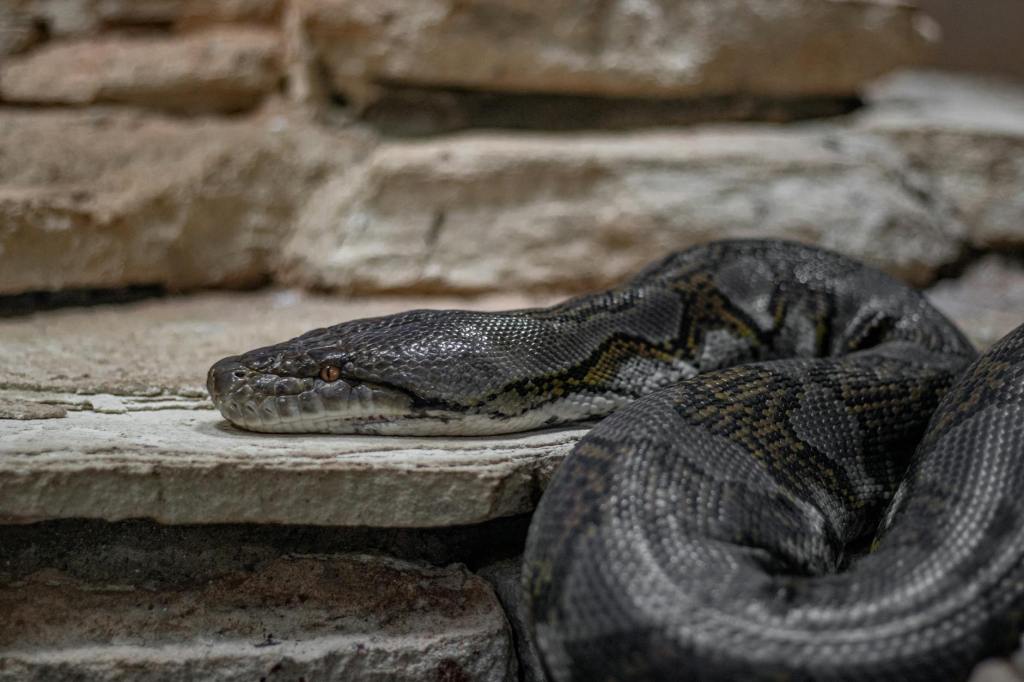
A snake came to my water-trough On a hot, hot day, and I in pyjamas for the heat, To drink there.
In the deep, strange-scented shade of the great dark carob tree I came down the steps with my pitcher And must wait, must stand and wait, for there he was at the trough before me.
He reached down from a fissure in the earth-wall in the gloom And trailed his yellow-brown slackness soft-bellied down, over the edge of the stone trough And rested his throat upon the stone bottom, And where the water had dripped from the tap, in a small clearness, He sipped with his straight mouth, Softly drank through his straight gums, into his slack long body, Silently.
Someone was before me at my water-trough, And I, like a second-comer, waiting.
He lifted his head from his drinking, as cattle do, And looked at me vaguely, as drinking cattle do, And flickered his two-forked tongue from his lips, and mused a moment, And stooped and drank a little more, Being earth-brown, earth-golden from the burning bowels of the earth On the day of Sicilian July, with Etna smoking.
The voice of my education said to me He must be killed, For in Sicily the black, black snakes are innocent, the gold are venomous.
And voices in me said, If you were a man You would take a stick and break him now, and finish him off.
But must I confess how I liked him, How glad I was he had come like a guest in quiet, to drink at my water-trough And depart peaceful, pacified, and thankless, Into the burning bowels of this earth?
Was it cowardice, that I dared not kill him? Was it perversity, that I longed to talk to him? Was it humility, to feel so honoured? I felt so honoured.
And yet those voices: If you were not afraid, you would kill him!
And truly I was afraid, I was most afraid, But even so, honoured still more That he should seek my hospitality From out the dark door of the secret earth.
He drank enough And lifted his head, dreamily, as one who has drunken, And flickered his tongue like a forked night on the air, so black, Seeming to lick his lips, And looked around like a god, unseeing, into the air, And slowly turned his head, And slowly, very slowly, as if thrice adream, Proceeded to draw his slow length curving round And climb again the broken bank of my wall-face.
And as he put his head into that dreadful hole, And as he slowly drew up, snake-easing his shoulders, and entered farther, A sort of horror, a sort of protest against his withdrawing into that horrid black hole, Deliberately going into the blackness, and slowly drawing himself after, Overcame me now his back was turned.
I looked round, I put down my pitcher, I picked up a clumsy log And threw it at the water-trough with a clatter.
I think it did not hit him, But suddenly that part of him that was left behind convulsed in an undignified haste, Writhed like lightning, and was gone Into the black hole, the earth-lipped fissure in the wall-front, At which, in the intense still noon, I stared with fascination.
And immediately I regretted it. I thought how paltry, how vulgar, what a mean act! I despised myself and the voices of my accursed human education.
And I thought of the albatross, And I wished he would come back, my snake.
For he seemed to me again like a king, Like a king in exile, uncrowned in the underworld, Now due to be crowned again.
And so, I missed my chance with one of the lords Of life. And I have something to expiate: A pettiness.
Until yesterday you were distracted, so although so much of the bardo state has appeared you have not recognised, and you have so much fear. If you are distracted now, the rope of compassion will be cut off and you will go to a place where there is no liberation, so be careful. – Tibetan Book of The Dead
“To say that the world is not worth anything, that this life is of no value and to give evil as the proof is absurd, for if these things are worthless what does evil take from us?
Thus the better we are able to conceive of the fullness of joy, the purer and more intense will be our suffering in affliction and our compassion for others. What does suffering take from him who is without joy?
And if we conceive the fullness of joy, suffering is still to joy what hunger is to food.
It is necessary to have had a revelation of reality through joy in order to find reality through suffering. Otherwise life is nothing but a more or less evil dream,” – Simone Weil, Gravity and Grace.


 Edge of Atlantic