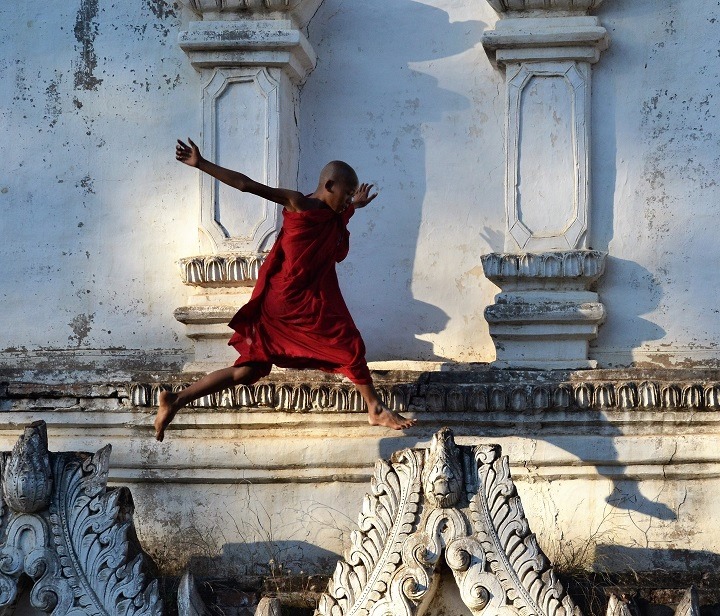
In the time of Shakyamuni Buddha, there lived a man in his eighties who had done little about his spiritual life, and so he set out to find the Buddha’s encampment, which he had heard was nearby. Looking like a beggar, old and hopeless, he arrived at the encampment and asked one of the senior monks if he could be accepted into the sangha.
After testing the old man’s attainment, the monk replied, “You are an old man and haven’t done any practice, so there’s no point in giving you teachings now.”
Completely dejected, the old man lay down in front of the door. When the Buddha came by, he asked the old man why he was lying there. The old man told his story, to which the Buddha replied: “Some of my monks don’t realize that just because the body is old, there’s still every reason to practice. All you need is courage and enthusiasm to study and meditate. I know you have insight and the roots of virtue. I will take care of you.”
Our being is not to be enriched merely by activity and experience as such. Everything depends on the quality of our acts and our experiences. A multitude of badly performed actions and of experiences only half-lived exhausts and depletes our being. By doing things badly we make ourselves less real. This growing unreality cannot help but make us unhappy and fill us with a sense of guilt. But the purity of our conscience has a natural proportion with the depth of our being and the quality of our acts: and when our activity is habitually disordered, our malformed conscience can think of nothing better to tell us than to multiply the quantity of our acts, without perfecting their quality. And so we go from bad to worse, exhaust ourselves, empty our whole life of all content, and fall into despair.
There are times, then, when in order to keep ourselves in existence at all we simply have to sit back for a while and do nothing. And for a man who has let himself be drawn completely out of himself by his activity, nothing is more difficult than to sit still and rest, doing nothing at all. The very act of resting is the hardest and most courageous act he can perform: and often it is quite beyond his power.
We must first recover the possession of our own being.
Those who think – and their name is legion – that they know how the universe could have been better than it is, how it would have been had they created it, without pain, without sorrow, without time, without life, are unfit for illumination. Or those who think as do many “Let me first correct society, then get around to myself” are barred from even the outer gate of the mansion of God’s peace. All societies are evil, sorrowful, inequitable; and so they will always be. So if you really want to help this world, what you will have to teach is how to live in it. And that no one can do who has not himself learned how to live in it in the joyful sorrow and sorrowful joy of the knowledge of life as it is. – Joseph Campbell
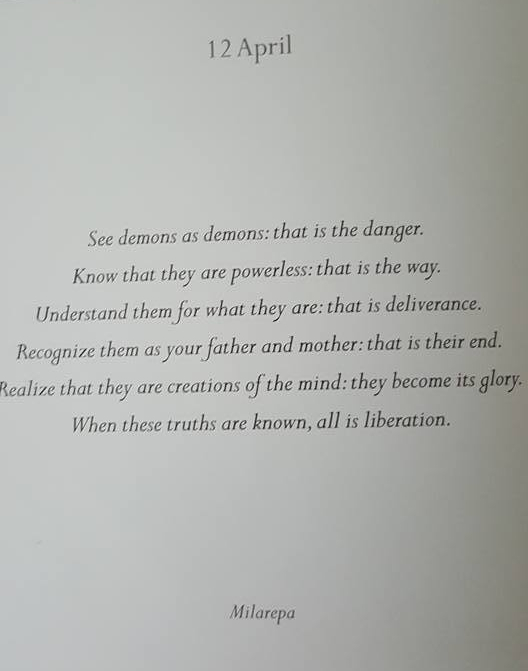
If there are obstacles, it cannot be space
If there are numbers, it cannot be stars
If it moves and shakes, it cannot be a mountain
If it grows and shrinks, it cannot be an ocean
If it must be crossed by a bridge, it cannot be a river
If it can be grasped, it cannot be a rainbow
These are the six parables of outer perception
–Milarepa
IN BUDDHISM, knowledge is regarded as an obstacle to understanding, like a block of ice that obstructs water from flowing. It is said that if we take one thing to be the truth and cling to it, even if truth itself comes in person and knocks at our door, we won’t open it. For things to reveal themselves to us, we need to be ready to abandon our views about them. – thich nhat hanh



 Edge of Atlantic