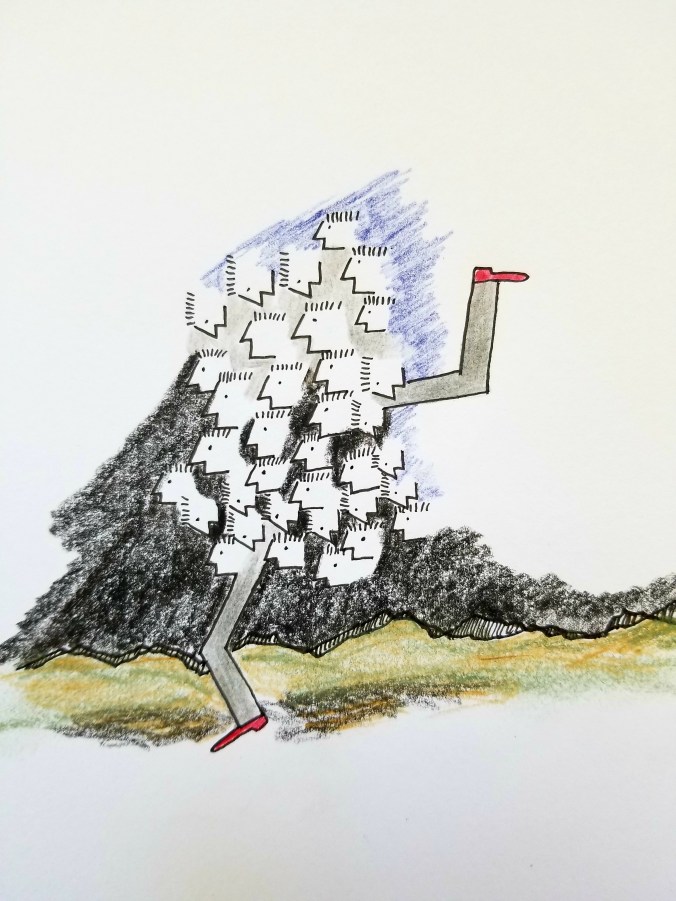
Respect the elders.
Embrace the new.
Encourage the impractical and improbable,
without bias.
– David Fricke
acceptance
Wounds & sacred wounds
Richard Rohr –
Pain teaches a most counterintuitive thing—that we must go down before we even know what up is. It is first an ordinary wound before it can become a sacred wound. Suffering of some sort seems to be the only thing strong enough to destabilize our arrogance and our ignorance. I would define suffering very simply as “whenever you are not in control.”
All healthy religion shows you what to do with your pain. If we do not transform our pain, we will most assuredly transmit it. If your religion is not showing you how to transform your pain, it is junk religion. It is no surprise that a crucified man became the central symbol of Christianity.
If we cannot find a way to make our wounds into sacred wounds, we invariably become negative or bitter—because we will be wounded. That is a given. All suffering is potentially redemptive, all wounds are potentially sacred wounds. It depends on what you do with them. Can you find God in them or not?
If there isn’t some way to find some deeper meaning to our suffering, to find that God is somehow in it, and can even use it for good, we will normally close up and close down, and the second half of our lives will, quite frankly, be small and silly.
#1000

A question in marriage
It is a question in marriage, to my feeling, not of creating a quick community of spirit by tearing down and destroying all boundaries, but rather a good marriage is that in which each appoints the other guardian of his solitude, and shows him this confidence, the greatest in his power to bestow. A togetherness between two people is an impossibility, and where it seems, nevertheless, to exist, it is a narrowing, a reciprocal agreement which robs either one party or both of his fullest freedom and development. But, once the realization is accepted that even between the closest human beings infinite distances continue to exist, a wonderful living side by side can grow up, if they succeed in loving the distance between them which makes it possible for each to see the other whole and against a wide sky!
Therefore this too must be the standard for rejection or choice: whether one is willing to stand guard over the solitude of a person and whether one is inclined to set this same person at the gate of one’s own solitude, of which he learns only through that which steps, festively clothed, out of the great darkness.
– Rainer Maria Rilke

Prayer by Eric Doyle, OFM
Lord of my origin
Draw me closer to you
Lord of my existence
Direct all my ways
Lord of my calling
Give me strength to go on
Lord of my faith
Preserve me from doubt
Lord of my hope
Keep me from despair
Lord of my love
Let me never grow cold
Lord of my past
May I never forget you
Lord of my present
Be near me always
Lord of my future
Keep me faithful to the end
Lord of my life
Let me live in your presence
Lord of my death
Receive me at last
Lord of my eternity
Bless me forever. Amen
(Photo: Evergreen Cemetery – Portland, Maine, August 2019)
Ask Me – William Stafford
Some time when the river is ice ask me
mistakes I have made. Ask me whether
what I have done is my life. Others
have come in their slow way into
my thought, and some have tried to help
or to hurt: ask me what difference
their strongest love or hate has made.
I will listen to what you say.
You and I can turn and look
at the silent river and wait. We know
the current is there, hidden; and there
are comings and goings from miles away
that hold the stillness exactly before us.
What the river says, that is what I say.
(Photo: Chama River, Abiquiu, New Mexico – September 2018)
August Prayer

This morning I give thanks
for breath
for breathing
I give thanks for
open windows and
French doors half-opened
and half-shut
This morning I give thanks
for clear glass tumblers
of cold Sebago water
and the crickets
of course and the crows
thanks for the cool
wash cloth
the comfort of hands
thanks for the taste of lemon
and the hair brush
this morning
I give thanks
for the shadow
that lingers a moment
then leaves the world
(photo: Portland, Maine – August 2014)
The Welcoming Prayer (by Father Thomas Keating)
Welcome, welcome, welcome.
I welcome everything that comes to me today
because I know it’s for my healing.
I welcome all thoughts, feelings, emotions, persons,
situations, and conditions.
I let go of my desire for power and control.
I let go of my desire for affection, esteem,
approval and pleasure.
I let go of my desire for survival and security.
I let go of my desire to change any situation,
condition, person or myself.
I open to the love and presence of God and
God’s action within. Amen.
two by Rilke
I Live My Life
I live my life in growing orbs,
which move out over the things of the world.
Perhaps I can never achieve the last,
but that will be my attempt.
I am circling around God, around the ancient tower,
and I have been circling for a thousand years,
and I still don’t know if I am a falcon, or a storm,
or a great song.
A Walk
My eyes already touch the sunny hill,
going far ahead of the road I have begun.
So we are grasped by what we cannot grasp;
it has its inner light, even from a distance –
and changes us, even if we do not reach it,
into something else, which, hardly sensing it, we already are;
a gesture waves us on, answering our own wave…
but what we feel is the wind in our faces.
(translated by Robert Bly)
Whole and holy people
Great love has the potential to open the heart space and then the mind space. Great suffering has the potential to open the mind space and then the heart space. Eventually both spaces need to be opened, and for such people, non-dual thinking can be the easiest.
People who have never loved or never suffered will normally try to control everything with an either-or attitude or all-or-nothing thinking. This closed system is all they are prepared for. The mentality that divides the world into “deserving and undeserving” has not yet experienced the absolute gratuity of grace or the undeserved character of mercy. This lack of in-depth God-experience leaves all of us judgmental, demanding, unforgiving, and weak in empathy and sympathy. Such people will remain inside the prison of “meritocracy,” where all has to be deserved. They are still counting when in reality God and grace exist outside of all accounting. Remember, however, to be patient with such people, even if you are the target of their judgment, because on some level, that is how they treat themselves as well.
Non-dual people will see things in their wholeness and call forth the same unity in others simply by being who they are. Wholeness (head, heart, and body all present, positive, and accounted for!) can see and call forth wholeness in others. This is why it is so pleasant to be around whole and holy people.
Dualistic or divided people, however, live in a split and fragmented world. They cannot accept or forgive certain parts of themselves. They cannot accept that God objectively dwells within them, as it states in so many places in Scripture, including 1 Corinthians 3:16-17. This lack of forgiveness takes the forms of a tortured mind, a closed heart, or an inability to live calmly and proudly inside ones own body. The fragmented mind sees parts, not wholes, in itself and others, and invariably it creates antagonism, reaction, fear, and resistance—“push-back” from other people—who themselves are longing for wholeness and holiness.
– Richard Rohr