If you want others to be more loving, choose to love first. If you want a reconciled outer world, reconcile your own inner world. If you are working for peace out there, create it inside as well. If you wish to find some outer stillness, find it within yourself. If you want to find God, then honor God within you, and you will always see God far beyond you, also. For it is only God in you who knows where and how to look for God. By ourselves, we are fairly blind.
This crisis is centered precisely in the country that has made a fetish out of action and has lost or perhaps never had the sense of contemplation. Far from being irrelevant, prayer, meditation and contemplation are of the utmost importance in America today. – Thomas Merton
I shall not believe you if in your next letter you tell me there’s nothing wrong with you. It is perhaps a more serious change, and I should not be surprised if you were a trifle low during the time it will take you to recover. In the fullness of artistic life there is, and remains, and will always come back at times, that homesick longing for the truly ideal life that can never come true.
And sometimes you lack all desire to throw yourself heart and soul into art, and to get well for that. You know you are a cab horse and that it’s the same old cab you’ll be hitched up to again: that you’d rather live in a meadow with the sun, a river and other horses for company, likewise free, and the act of procreation. And perhaps, to get to the bottom of it, the disease of the heart is caused by this; it would not surprise me. One does not rebel against things, nor is one resigned to them; one’s ill because of them, and one does not get better, and it’s hard to be precise about the cure.
“In the fullness of artistic life there is, and remains, and will always come back at times, that homesick longing for the truly ideal life that can never come true.”
I do not know who it was who called this condition-being struck by death and immortality. The cab you drag along must be of some use to people you do not know. And so, if we believe in the new art and in the artists of the future, our faith does not cheat us. When good old Corot said a few days before his death-“Last night in a dream I saw landscapes with skies all pink,” well, haven’t they come, those skies all pink, and yellow and green into the bargain, in the impressionist landscapes? All of which means that there are things one feels coming, and they are coming in very truth.
And as for us who are not, I am inclined to believe, nearly so close to death we nevertheless feel that this thing is greater than we are, and that its life is of longer duration than ours.
We do not feel we are dying, but we do feel the truth that we are of small account, and that we are paying a hard price to be a link in the chain of artists in health, in youth, in liberty, none of which we enjoy, any more than the cab horse that hauls a coachful of people out to enjoy the spring.
So what I wish for you, as for myself, is to succeed in getting back your health, because you must have that. That “Espérance” by Puvis de Chavannes is so true. There is an art of the future, and it is going to be so lovely and so young that even if we give up our youth for it, we must gain in serenity by it. Perhap it is very silly to write all this, but I feel it so strongly; it seems to me that, like me, you have been suffering to see your youth pass away like a puff of smoke but if it grows again, and comes to life in what you make, nothing has been lost and the power to work is another youth. Take some pains then to get well, for we shall need your health.
I When after a long silence one picks up the pen And leans over the paper and says to himself: Today I shall consider Marsyas
Whose body was flayed to an excess Of nakedness, who made no crime that would square With what he was made to suffer.
Today I shall consider the shredded remains of Marsyas What do they mean as they gather the sunlight That falls in small pieces through the trees,
As in Titian’s late painting. Poor Marsyas, A body, a body of work as it turns and falls Into suffering, becoming the flesh of light,
Which is fed to onlookers centuries later. Can this be the cost of encompassing pain? After a long silence, would I, whose body
Is whole, sheltered, kept in the dark by a mind That prefers it that way, know what I’d done And what its worth was? Or is a body scraped
From the bone of experience, the chart of suffering To be read in such ways that all flesh might be redeemed, At least for the moment, the moment it passes into song.
II Our friends who lumbered from room to room Now move like songs or meditations winding down, Or lie about, waiting for the next good thing
Some news of what is going on above, A visitor to tell them who’s writing well, Who’s falling in or out of love.
Not that it matters anymore. Just look around. There’s Marsyas, noted for his marvelous asides On Athena’s ancient oboe, asleep for centuries.
And Arion, whose gaudy music drove the Phrygians wild, Hasn’t spoken in a hundred years. The truth is Soon the song deserts its maker,
The airy demon dies, and others come along. A different kind of dark invades the autumn woods, A different sound sends lovers packing into sleep.
The air is full of anguish. The measures of nothingness Are few. The Beyond is merely beyond, A melancholy place of failed and fallen stars.
III I am sure you would find it misty here, With lots of stone cottages badly needing repair. Groups of souls, wrapped in cloaks, sit in the fields
Or stroll the winding unpaved roads. They are polite, And oblivious to their bodies, which the wind passes through, Making a shushing sound. Not long ago,
I stopped to rest in a place where an especially Thick mist swirled up from the river. Someone, Who claimed to have known me years before,
Approached, saying there were many poets Wandering around who wished to be alive again. They were ready to say the words they had been unable to say
Words whose absence had been the silence of love, Of pain, and even of pleasure. Then he joined a small group, Gathered beside a fire. I believe I recognized
Some of the faces, but as I approached they tucked Their heads under their wings. I looked away to the hills Above the river, where the golden lights of sunset
And sunrise are one and the same, and saw something flying Back and forth, fluttering its wings. Then it stopped in mid-air. It was an angel, one of the good ones, about to sing.
Some days when you look out, the land is heavy, following its hills, dim where the road bends. There are days when having the world is a mistake. But then you think, “Well, anyway, it wasn’t my idea,” and it’s OK again.
Suppose that a person who knows you happens to see you going by, and it’s one of those days – for a minute you have to carry the load for them, you’ve got to lift the whole heavy world, even without knowing it, being a hero, stumbling along. Some days it’s like that. And maybe today. And maybe all the time.
But living into grace does not depend upon simple receptivity alone. It also requires an active attempt to live life in accord with the facts of grace, even when we do not sense them directly. The facts of grace are simple: grace always exists, it is always available, it is always good, and it is always victorious. For me, living into grace means trying to act on the basis of these facts. I do not do well at it.
My life has given me plenty of real evidence for the facts of grace, and they are – certainly verified in my prayer. But whenever I try to live in accord with them it seems I am taking a risk. The risk, of course, is to my addictions; if I try to live in accord with grace, then I will be relinquishing the gods I have made of my attachments. Grace threatens all my normalities. In defense, I am likely to try to distort what I know about the facts of grace or forget them entirely. Thus I must make conscious efforts of will; I must struggle with myself if I am going to act in accord with those facts. Living into grace requires taking risks of faith.

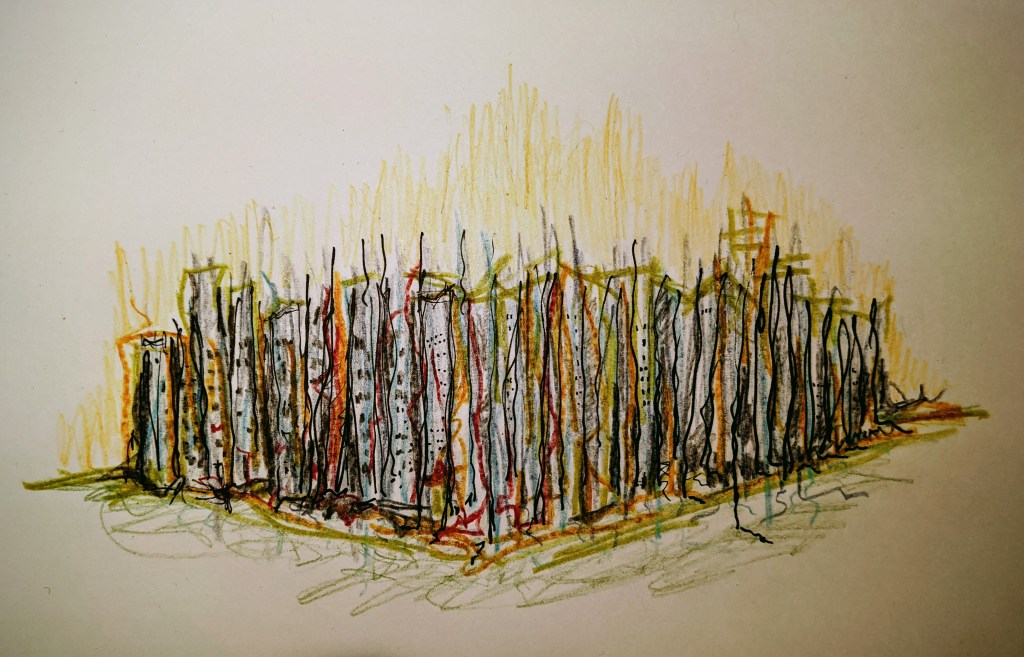


 Edge of Atlantic