for Susan
Rest in Peace
for Susan
Rest in Peace

Photo by Drigo Diniz on Pexels.com
All men seek peace first of all with themselves. That is necessary, because we do not naturally find rest even in our own being. We have to learn to commune with ourselves before we can communicate with other men and with God. A man who is not at peace with himself necessarily projects his interior fighting into the society of those he lives with, and spreads a contagion of conflict all around him. Even when he tries to do good to others his efforts are hopeless, since he does not know how to do good to himself. In moments of wildest idealism he may take it into his head to make other people happy and in doing so he will overwhelm them with his own unhappiness. He seeks to find himself somehow in the work of making others happy. Therefore he throws himself into the work. As a result he gets out of the work all that he puts into it: his own confusion, his own disintegration, his own unhappiness.
– Thomas Merton
This after-sunset is a sight for seeing,
Cliff-heads of craggy cloud surrounding it.
—And dwell you in that glory-show?
You may; for there are strange strange things in being,
Stranger than I know.
Yet if that chasm of splendour claim your presence
Which glows between the ash cloud and the dun,
How changed must be your mortal mould!
Changed to a firmament-riding earthless essence
From what you were of old:
All too unlike the fond and fragile creature
Then known to me….Well, shall I say it plain?
I would not have you thus and there,
But still would grieve on, missing you, still feature
You as the one you were.


On this day in 1944, my Dad was a 25 year-old first lieutenant in the 4th infantry, leading the men in a landing craft like this into really unknown waters.
He made it to the outskirts of Ste. Mere Eglise, where he was hit with grenade shrapnel. His left arm and hand were significantly damaged; shrapnel remained in his body for the rest of his too-short life, including in his eyes.
He’s always been my hero.
This poem is for him, William John Schulz, Jr.
Wounds and Scars
I have two noticeable scars
one on my forehead
from falling with a girl
on my back the other from
breaking a salt shaker in my hand
just before my first divorce
some wounds heal
from the inside out
raw and open for months
some wounds may never scar
Jesus had holy wounds
and Hemingway of course
Francis of Assisi had stigmata
as if Jesus was inside him
my father had shrapnel wounds
from a battle in France
I’d touch the scar on his chin
and he’d growl then laugh
over and over until
we both laughed and cried
 “Each time a man stands up for an ideal, or acts to improve the lot of others, or strikes out against injustice, he sends forth a tiny ripple of hope, and crossing each other from a million different centers of energy and daring those ripples build a current which can sweep down the mightiest walls of oppression and resistance.”
― Robert F. Kennedy

 For some “faithful” – and for unbelievers too – “faith” seems to be a kind of drunkenness, an anesthetic, that keeps you from realizing and believing that anything can ever go wrong. Such faith can be immersed in a world of violence and make no objection: the violence is perfectly all right. It is quite normal – unless of course it happens to be exercised by negroes. Then it must be put down instantly by superior force. The drunkenness of this kind of faith – whether in a religious message or merely in a political ideology – enables us to go through life without seeing that our own violence is a disaster and that the overwhelming force by which we seek to assert ourselves and our own self-interest may be our ruin.
Is faith a narcotic dream in a world of heavily-armed robbers, or is it an awakening?
Is faith a convenient nightmare in which we are attacked and obliged to destroy our attackers?
What if we awaken to discover that we are the robbers, and our destruction comes from the root of hate in ourselves?
– Thomas Merton, from Faith and Violence, 1968

(my granddaughter, Fin, posing the question)
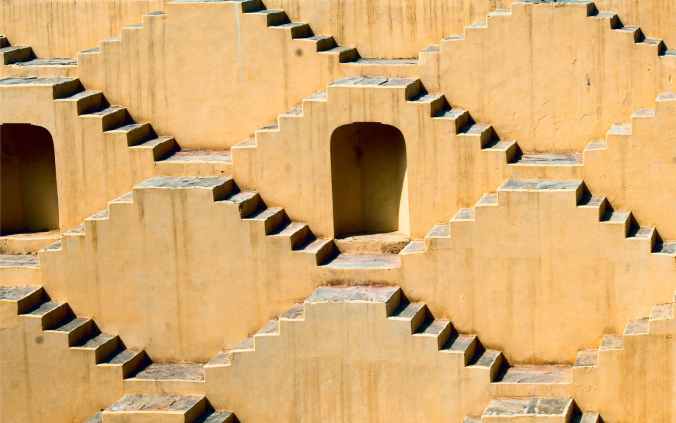
Photo by Ankush Rathi on Pexels.com
Moses put a low gate in the Jerusalem wall,
so that even unconsciously
everyone would have to put down his pack
and lower his head, bowing at least that much,
as though to say,
I pray that I can put down what I carry.
The function given kings and all authorities
is so that people who won’t bow down
and surrender to the presence
will have one place where they are humble.
The gate was called Babi-Saghir,
the little door.
Consider the world-power you acknowledge
as a small gate you must go through
to pay homage to a dunghill,
and instead of doing that, recognize the holy ones,
who are sweet as sugarcane.
Don’t grovel in front of political leaders.
Not your highness, say your lowness
to those empty weed-stems. Honor the sun we see by.
Don’t play a cat-and-mouse game.
Join the lion and swift deer in their hunt for soul.
Let pot-lickers follow the big basin-licker.
I could continue and make some rulers and administrators
very angry. They know who I’m talking about.
 Edge of Atlantic