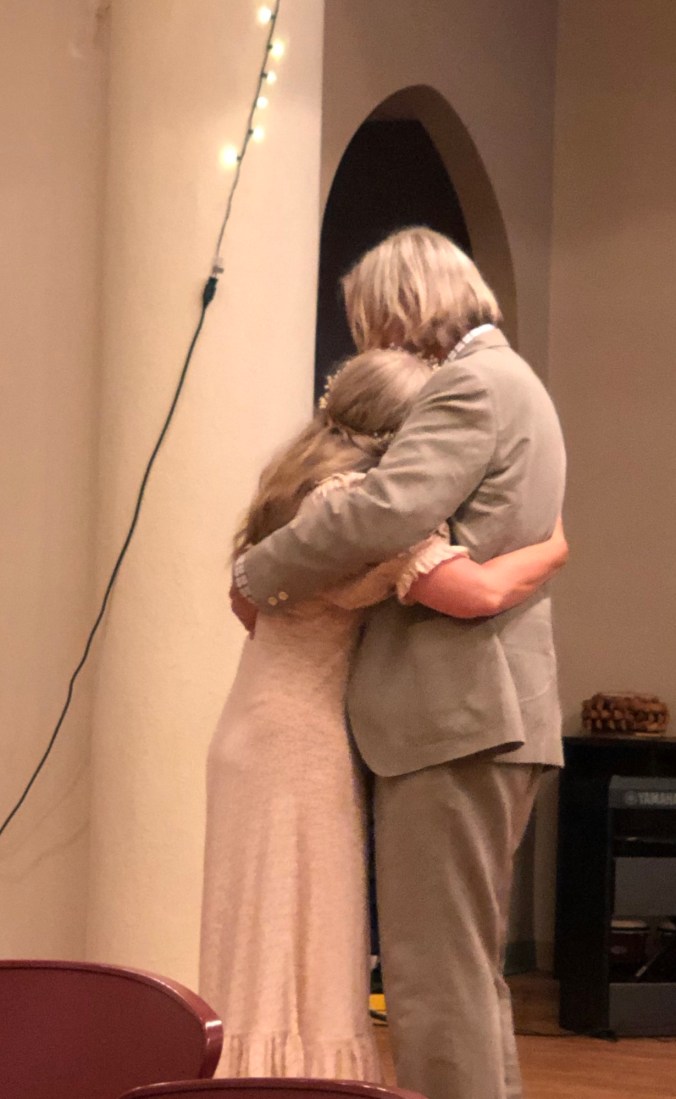
Take two bodies and twirl them into one…hearts and bones…and they won’t come undone (Paul Simon)
Some time when the river is ice ask me
mistakes I have made. Ask me whether
what I have done is my life. Others
have come in their slow way into
my thought, and some have tried to help
or to hurt: ask me what difference
their strongest love or hate has made.
I will listen to what you say.
You and I can turn and look
at the silent river and wait. We know
the current is there, hidden; and there
are comings and goings from miles away
that hold the stillness exactly before us.
What the river says, that is what I say.

(Photo: Chama River, Abiquiu, New Mexico – September 2018)

This morning I give thanks
for breath
for breathing
I give thanks for
open windows and
French doors half-opened
and half-shut
This morning I give thanks
for clear glass tumblers
of cold Sebago water
and the crickets
of course and the crows
thanks for the cool
wash cloth
the comfort of hands
thanks for the taste of lemon
and the hair brush
this morning
I give thanks
for the shadow
that lingers a moment
then leaves the world
(photo: Portland, Maine – August 2014)
Welcome, welcome, welcome.
I welcome everything that comes to me today
because I know it’s for my healing.
I welcome all thoughts, feelings, emotions, persons,
situations, and conditions.
I let go of my desire for power and control.
I let go of my desire for affection, esteem,
approval and pleasure.
I let go of my desire for survival and security.
I let go of my desire to change any situation,
condition, person or myself.
I open to the love and presence of God and
God’s action within. Amen.
What souls desire arrives.
We are standing up to our necks
in the sacred pool. Majesty is here.
The grains of the earth take in something
they do not understand.
Where did this come from?
It comes from where your longing comes.
From which direction?
As ripeness comes to fruit.
This answer lights a candle
in the chest of anyone who hears.
Most people only look for the way when they hurt.
Pain is a fine path to the unknowable.
But today is different.
Today the quality we call splendor
puts on human clothes, walks through the door,
closes it behind, and sits down with us
in this companionship.
I live my life in growing orbs,
which move out over the things of the world.
Perhaps I can never achieve the last,
but that will be my attempt.
I am circling around God, around the ancient tower,
and I have been circling for a thousand years,
and I still don’t know if I am a falcon, or a storm,
or a great song.
My eyes already touch the sunny hill,
going far ahead of the road I have begun.
So we are grasped by what we cannot grasp;
it has its inner light, even from a distance –
and changes us, even if we do not reach it,
into something else, which, hardly sensing it, we already are;
a gesture waves us on, answering our own wave…
but what we feel is the wind in our faces.
(translated by Robert Bly)
To keep the spirit of eternal youth active in us during the second half of life, we must learn again to play with our experience. Recall the joy of discovery before it bowed to work, obligation, and duty. Movement is alive; inertia is dead. We become more “unalive” as we cling to that which is predictable and unchanging. Enthusiasm is closely related to the spirit of play – the word comes from the ancient Greek theos, meaning “god.” To have enthusiasm is to allow yourself to be filled with divine assistance, so the ego does not need to handle your tasks by itself.
– Robert A. Johnson, from Living Your Unlived Life

This image of the former Franciscan School of Theology in Berkeley, CA goes straight to my heart. It was right about this time in 2003 that I climbed “Holy Hill” in Berkeley and first laid eyes on FST – the beautiful Tuscan yellow building at the top of the hill – the corner of Euclid and LeConte. I spent the next three years there immersed in the spirit of Francis and Clare of Assisi. I am so grateful for that time.
FST is now affiliated with The University of San Diego (https://www.fst.edu/)
Great love has the potential to open the heart space and then the mind space. Great suffering has the potential to open the mind space and then the heart space. Eventually both spaces need to be opened, and for such people, non-dual thinking can be the easiest.
People who have never loved or never suffered will normally try to control everything with an either-or attitude or all-or-nothing thinking. This closed system is all they are prepared for. The mentality that divides the world into “deserving and undeserving” has not yet experienced the absolute gratuity of grace or the undeserved character of mercy. This lack of in-depth God-experience leaves all of us judgmental, demanding, unforgiving, and weak in empathy and sympathy. Such people will remain inside the prison of “meritocracy,” where all has to be deserved. They are still counting when in reality God and grace exist outside of all accounting. Remember, however, to be patient with such people, even if you are the target of their judgment, because on some level, that is how they treat themselves as well.
Non-dual people will see things in their wholeness and call forth the same unity in others simply by being who they are. Wholeness (head, heart, and body all present, positive, and accounted for!) can see and call forth wholeness in others. This is why it is so pleasant to be around whole and holy people.
Dualistic or divided people, however, live in a split and fragmented world. They cannot accept or forgive certain parts of themselves. They cannot accept that God objectively dwells within them, as it states in so many places in Scripture, including 1 Corinthians 3:16-17. This lack of forgiveness takes the forms of a tortured mind, a closed heart, or an inability to live calmly and proudly inside ones own body. The fragmented mind sees parts, not wholes, in itself and others, and invariably it creates antagonism, reaction, fear, and resistance—“push-back” from other people—who themselves are longing for wholeness and holiness.
– Richard Rohr
 Edge of Atlantic