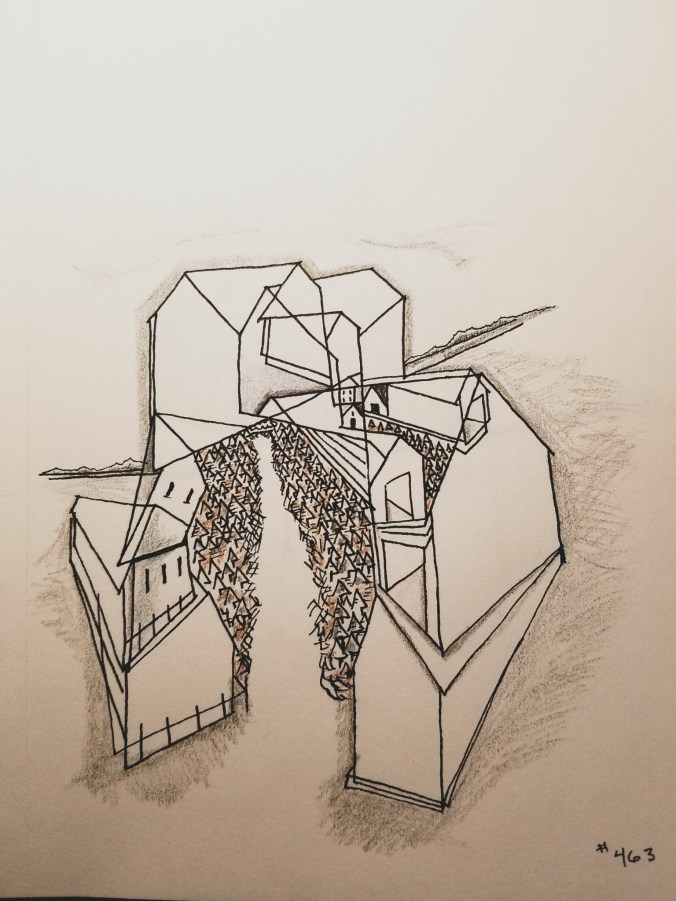
Another small town – #463
ABBA MOSES hesitated to accept a summons to be part of a council that would pass judgment on a brother who had committed a sin. A delegation approached him insisting that all the others were waiting for him. Reluctantly, he got up and went with them. He took a jug of water that leaked all along the path. The council came outside to greet him. Puzzled by the water jug, they asked for an explanation. Moses said, “My sins pour out behind me, and I have the audacity to come here today to judge someone else’s errors.” Hearing this, they forgave the sinful brother and sent him on his way.

 written by Father Ronald Rolheiser
In his memoir, Report to Greco, Nikos Kazantzakis shares this story: As a young man, he spent a summer in a monastery during which he had a series of conversations with an old monk. One day he asked the old monk: “Father, do you still do battle with the devil?” The old monk replied: “No, I used to, when I was younger, but now I have grown old and tired and the devil has grown old and tired with me. I leave him alone and he leaves me alone.” “So your life is easy then?” remarked Kazantzakis. “Oh no,” replied the monk, “it’s much worse, now I wrestle with God!”
There’s a lot contained in that remark – “I wrestle with God.” Among other things, it suggests that the struggles in later life can be very different than what we struggle with earlier on. In the normal pattern of things, we spend the first-half of our lives struggling with sensuality, greed, and sexuality, and spend the last half of our lives struggling with anger and forgiveness – and that anger is often, however unconsciously, focused on God. In the end, our real struggle is with God.
But wrestling with God has another aspect. It invites us to a certain kind of prayer. Prayer isn’t meant to be a simple acquiescence to God’s will. It’s meant to be an acquiescence, yes, but a mature acquiescence, come to at the end of a long struggle.
We see this in the prayer of the great figures in scripture: Abraham, Moses, Jesus, the apostles. Abraham argues with God and initially talks him out of destroying Sodom; Moses at first resists his call, protesting that his brother is better suited for the job; the apostles excuse themselves for a long time before finally putting their lives on the line; and Jesus gives himself over in the Garden of Gethsemane only after first begging his Father for a reprieve. As Rabbi Heschel puts it, from Abraham through Jesus we see how the great figures of our faith are not in the habit of easily saying: “Thy will be done!” but often, for a while at least, counter God’s invitation with: “Thy will be changed!”
Struggling with God’s will and offering resistance to what it calls us to can be a bad thing, but it can also be a mature form of prayer. The Book of Genesis describes an incident where Jacob wrestled with a spirit for a whole night and in the morning that spirit turned out to be God. What a perfect icon for prayer! A human being and God, wrestling in the dust of this earth! Doesn’t that accurately describe the human struggle?
We would do well to integrate this, the concept of wrestling with God, into our understanding of faith and prayer. We honor neither ourselves nor the scriptures when we make things too simple. Human will doesn’t bend easily, nor should it, and the heart has complexities that need to be respected, even as we try to rein in its more possessive longings. God, who built us, understands this and is up to the task of wrestling with us and our resistance.
The classical mystics speak of something they call “being bold with God”. This “boldness”, they suggest, comes not at the beginning of the spiritual journey, but more towards the end of it, when, after a long period of fidelity, we are intimate enough with God to precisely be “bold”, as friends who have known each other for a long time have a right to be. That’s a valuable insight: After you have been friends with someone for a long time, you can be comfortable with expressing your needs to him or her and in the context of a long, sustained relationship unquestioning reverence is not necessarily a sign of mature intimacy. Old friends, precisely because they know and trust each other, can risk a boldness in their friendship that younger, less mature, friendship cannot.
That is also true in our relationship with God. God expects that, at some point, we will kick against his will and offer some resistance. But we should lay out our hearts in honesty. Jesus did.
God expects some resistance. As Nikos Kazantzakis puts it:
The struggle between God and humans breaks out in everyone, together with the longing for reconciliation. Most often this struggle is unconscious and short-lived. A weak soul does not have the endurance to resist the flesh for very long. It grows heavy, becomes flesh itself, and the contest ends. But among responsible persons who keep their eyes riveted day and night upon the supreme duty, the conflict between flesh and spirit breaks out mercilessly and may last until death. The stronger the soul and the flesh, the more fruitful the struggle and the richer the final harmony. The spirit wants to have to wrestle with flesh which is strong and full of resistance. It is a carnivorous bird which is incessantly hungry; it eats flesh and, by assimilating it, makes it disappear.
The only requirement for membership in AA is a desire to stop drinking.
Let me sum up, then, the foundational ways that I believe Jesus and the Twelve Steps of A.A. are saying the same thing but with different vocabulary:
We suffer to get well. We surrender to win. We die to live. We give it away to keep it.
This counterintuitive wisdom will forever be resisted as true, denied, and avoided, until it is forced upon us – by some reality over which we are powerless – and if we are honest, we are all powerless in the presence of full reality. – Richard Rohr OFM, Breathing Under Water: Spirituality and the Twelve Steps
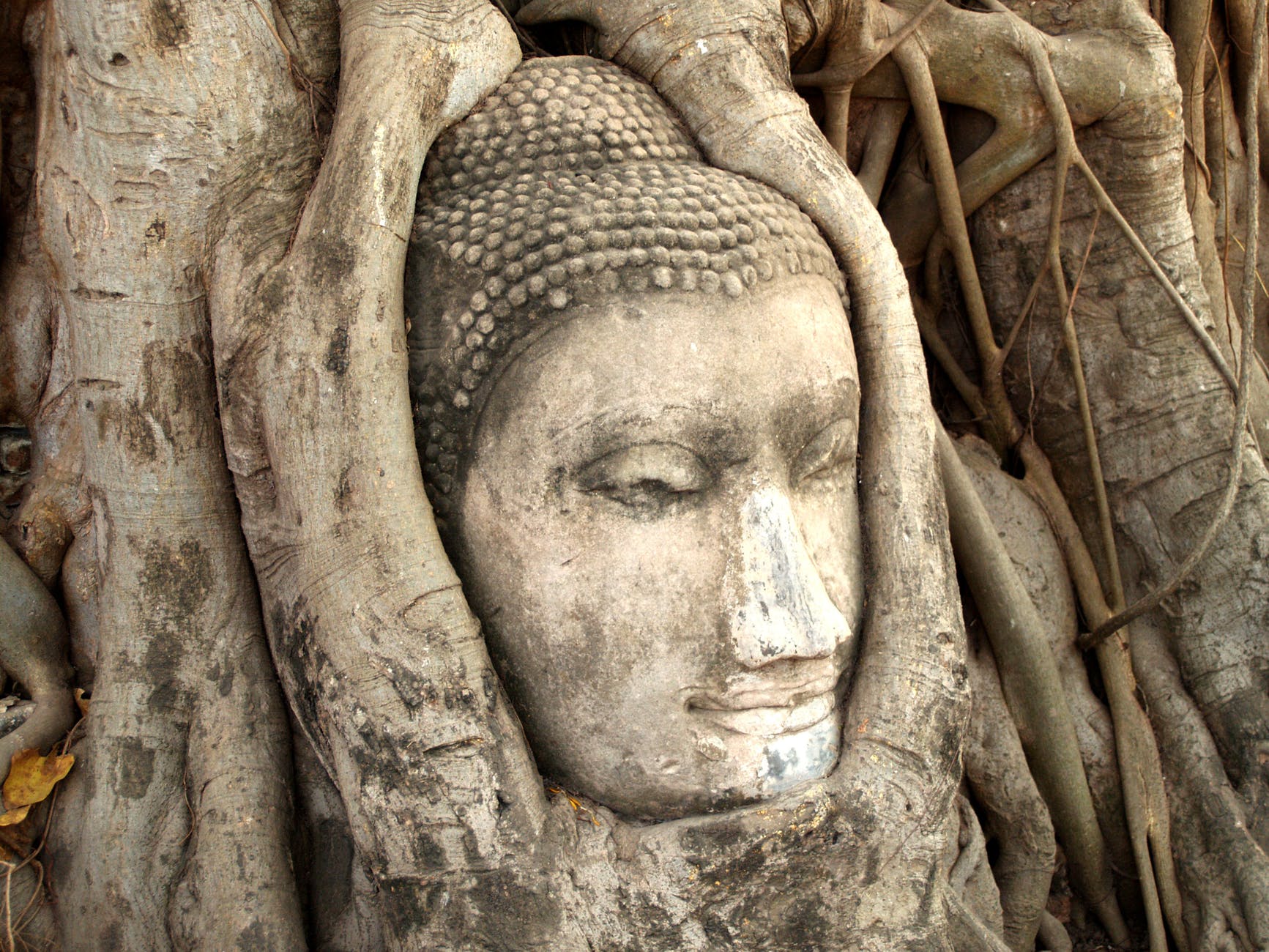
From Dropping Ashes on the Buddha: The Teachings of Zen Master Seung Sahn
Soen-sa recounts his conversation with Gita, the seven-year-old daughter of one of his students at the Cambridge Zen Center, after the death of the center’s beloved cat, cleverly named Katz. (“KATZ!” is the transcription of the famous Buddhist belly-shout, used as a way of focusing energy and intention during Zen practice.) Katz had died after a long illness and was given a traditional Buddhist burial, but the little girl remained troubled by his death. One day after practice, she came to the great Zen teacher for an explanation. He relays the exchange:
“What happened to Katzie? Where did he go?”
Soen-sa said, “Where do you come from?”
“From my mother’s belly.”
“Where does your mother come from?” Gita was silent.
Soen-sa said, “Everything in the world comes from the same one thing. It is like in a cookie factory. Many different kinds of cookies are made — lions, tigers, elephants, houses, people. They all have different shapes and different names, but they are all made from the same dough and they all taste the same. So all the different things that you see — a cat, a person, a tree, the sun, this floor — all these things are really the same.”
“What are they?”“People give them many different names. But in themselves, they have no names. When you are thinking, all things have different names and different shapes. But when you are not thinking, all things are the same. There are no words for them. People make the words. A cat doesn’t say, ‘I am a cat.’ People say, ‘This is a cat.’ The sun doesn’t say, ‘My name is sun.’ People say, ‘This is the sun.’
So when someone asks you, ‘What is this?’, how should you answer?”
“I shouldn’t use words.”
Soen-sa said, “Very good! You shouldn’t use words. So if someone asks you, ‘What is Buddha?’, what would be a good answer?”
Gita was silent.
Soen-sa said, “Now you ask me.”
“What is Buddha?”
Soen-sa hit the floor.
Gita laughed.
Soen-sa said, “Now I ask you: What is Buddha?”
Gita hit the floor.
“What is God?”
Gita hit the floor.
“What is your mother?”
Gita hit the floor.
“What are you?”
Gita hit the floor.
“Very good! This is what all things in the world are made of. You and Buddha and God and your mother and the whole world are the same.”
Gita smiled.
Soen-sa said, “Do you have any more questions?”
“You still haven’t told me where Katz went.”
Soen-sa leaned over, looked into her eyes, and said, “You already understand.”
Gita said, “Oh!” and hit the floor very hard. Then she laughed.
 He recognized the myriad pressures on a suicidal mind—substance abuse, genetic predisposition to mental illness, poverty—but identified three factors present in all of those most at risk: a genuine belief, however irrational, that they have become a burden to those around them; a sense of isolation; and the ability, which goes against our hard-wired instincts of self-preservation, to hurt oneself (this combines access to a means of suicide with what Joiner describes as a “learned fearlessness”; Covington calls it an “acquired capability”).
https://www.theatlantic.com/health/archive/2017/08/zero-suicide-strategy/535587/
Wait – Galway Kinnell
Wait, for now.
Distrust everything if you have to.
But trust the hours. Haven’t they
carried you everywhere, up to now?
Personal events will become interesting again.
Hair will become interesting.
Pain will become interesting.
Buds that open out of season will become interesting.
Second-hand gloves will become lovely again;
their memories are what give them
the need for other hands. The desolation
of lovers is the same: that enormous emptiness
carved out of such tiny beings as we are
asks to be filled; the need
for the new love is faithfulness to the old.
Wait.
Don’t go too early.
You’re tired. But everyone’s tired.
But no one is tired enough.
Only wait a little and listen:
music of hair,
music of pain,
music of looms weaving our loves again.
Be there to hear it, it will be the only time,
most of all to hear your whole existence,
rehearsed by the sorrows, play itself into total exhaustion.
Happy first birthday to my friend, confidant, and constant companion Dave! Through the good and bad days and nights, you’ve modeled a right response – hang in the tank peacefully and let God take care of the rest!
Thanks, Dave!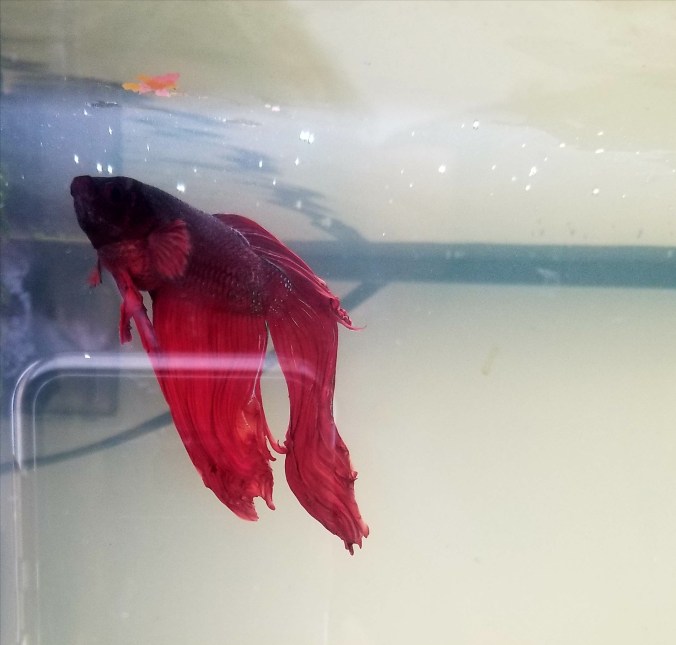


 Edge of Atlantic